
Racing the Reaper Man to Ultra: January 2022

There was no neat and tidy end to my Racing the Reaper Man Year. Although successful in hitting my fitness and running targets, with a leaner body and in reasonable health, I ended December 750 road-miles from home. As I’ve outlined in my December blog post, my brother’s wife died on the morning of Christmas Eve, so, with my Passepartout, I had to drive to Scotland:
‘For a week we supported a grieving man as best we could. I spent days sorting paperwork, important documents, forming a strategy and helping with the legal requirements of a sudden death in Scotland. I ran a short distance at the end of each day (mainly with Passepartout) at the point I could no longer make sense of documents. We would [then] call a halt, raise a glass of sherry to the lovely Sue, then try to fill the early Scottish evening with hope. I was now beyond-burnout. In fact, I had become a machine running on banked fitness… We did not notice 2022 arrive and I was 750 miles from home surrounded by sadness…’
On New Year’s Day 2022, none of us really noticed the change in year. Another day of sifting documents and finding a strategy for my brother and we were very near completion of this dreadfully sad task. We ran 3 miles into the Morayshire greyness just before the early, northern dark, thus starting the New Year maintaining our running streaks. These runs proved to be the one thing that kept me focused enough to carry on. Finally, on Sunday 2nd January the paperwork came to an end. Everything I could do was done. It was heartbreaking to leave my brother the next day. We had shared a close bond since childhood, and the week I had been with him had reinforced that bond. I had taken the lead and hoped I’d done enough to reduce his grief a little.
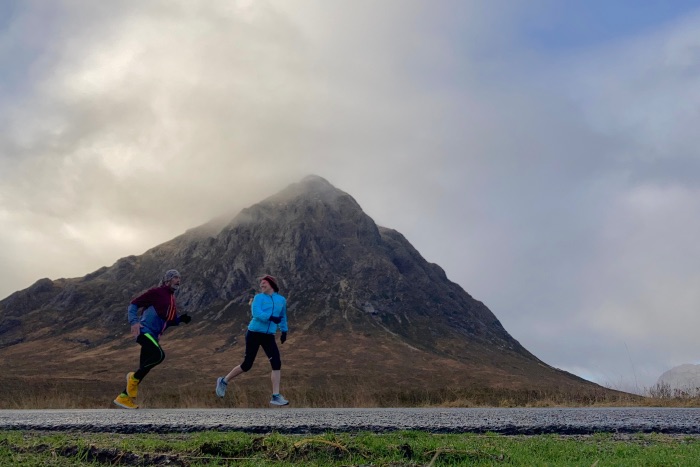
We left in the rain. My own health was not good. I have never been so mentally tired, so had decided to break up the journey home into segments. The first stage was 200 miles to Dumfries and Galloway, via Loch Ness and Glencoe. The rain was biblical. We made a brief stop at Spean Bridge for hot soup, then paused just south of Glencoe to run a chilly mile in Glen Etive. I had needed this to clear my head. We arrived at the Hetland Hall Hotel as the light went.
I was in trouble. I was beyond burnout, shaking and occasionally losing a few seconds of conscious thought. We ended up staying at the hotel for 3 nights so I could recover a little, leaving through necessity as a snow bank moved south, overtaking us as we drove over Shep Fell. We stopped in Staffordshire, then near Loughborough to break the journey down. The final 200 mile leg was directly south into a storm, with heavy rain blowing directly at the windscreen the whole way. Never have I felt so relieved to get home. We’d been on the road for two weeks.
To say I was ill was an understatement. Every sleep was full of nightmares and every waking moment saw me full of anxiety. All I did was stick to the formula: eat healthily, run every day and be confident that recovery would happen. My Passepartout had to return home. She had kept me together on the journey, cooked and served my brother and me, and helped me see the sense of breaking up the journey from Scotland. She gave up Christmas without question, supported me selflessly and ran by my side every day. Now she had to catch up with her own commitments.

Alone, rest would not come. I called my brother every day, and watched his wife’s funeral on livestream. My MRI Scan happened a few days later and I suddenly started to worry about my own mortality. My GP knew I needed more time, so any return to working would have to wait. All of this with the pandemic constantly in the background. Being candid is not so easy. However, my aim is to show the reality of the constant runner who appears on Facebook. All of us have different pressures. In photographs we tend to smile, thus hiding the burdens we carry. I’m generally a happy man. Losing my smile is not pleasant, yet I’m confident the last year’s successes will get me through the coming weeks.
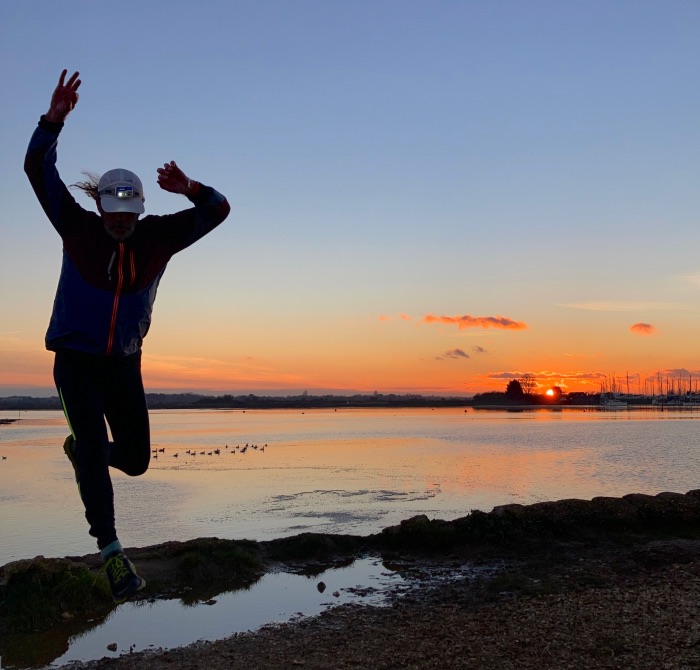
Running really does make me happy. Over the last few weeks, the only thing that kept me sane was my daily run. As I have written, I decided to extend my self-experiment into 2022, thus starting a Racing the Reaper Man to Ultra year. This way I could catalogue my recovery and my drive towards my first ever 100k. This blog post is the first.
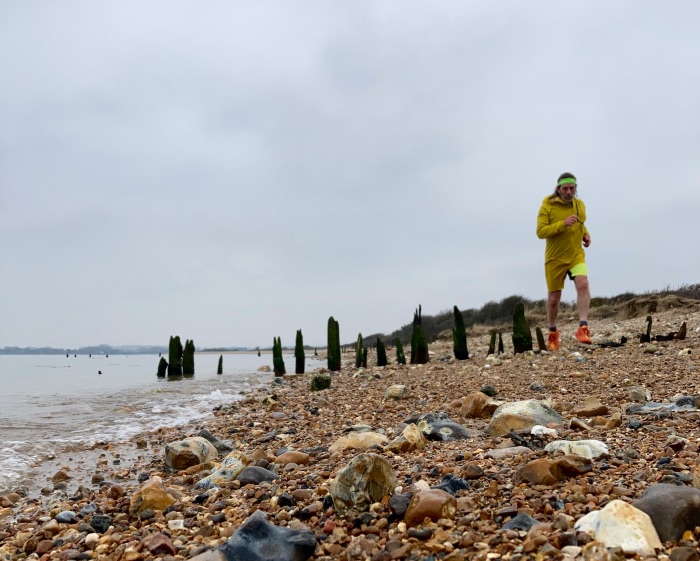
By the end of January I had started to get a strategy in place to get me to a full recovery. I also needed to start my strategy to get through my June 100k. The good thing was, my baseline fitness remained at a high level. I tested myself on a 10 mile run around Thorney Island, then ran a comfortable, quick 12 miler (9:42 mins/mile) on the 30th, which was also my 400th day without a rest day. I’d started weekly core work with Martin once more and looked at February as my kick off month. I would start to take regular fitness statistics once more and focus on Ultra. Yet, mentally I was not in a good place. My hopes for quick mental recovery had stalled on the anvil of duty. My mind could not switch off, even whilst asleep. I was starting to see I might need some professional help to realign body and mind.
Racing the Reaper Man to Ultra: February 2022
It has become apparent to me, that my book, Racing the Reaper Man, must have a chapter on mental wellbeing. I have shown how getting physically fitter and healthier is not beyond us as we get beyond 50, but I am now having to apply my philosophy to restoring my mental health. In doing so, I have to be candid about my personal issues, which is not easy, but if it helps others, I think it is worthwhile. Let me explain.
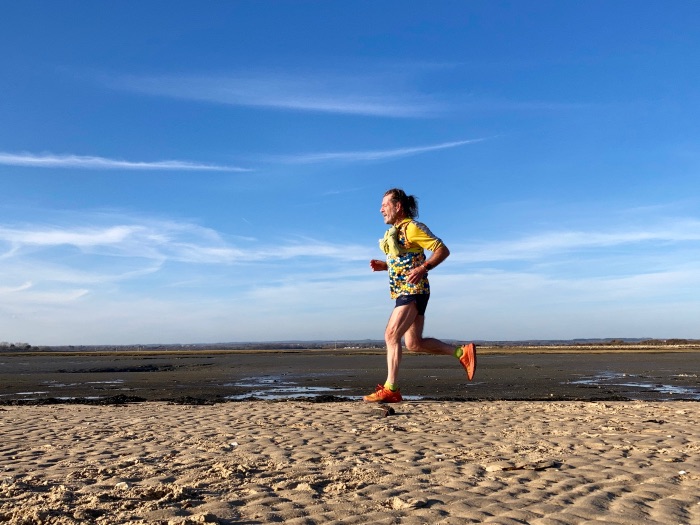
Poor mental health has dogged me through February. It is difficult to unravel fully, but burnout is the overarching diagnosis. To me this makes sense. Ultimately, I worked too many long hours, flattened my ‘wellbeing battery’ and the net result is a mind with no immunity from stress. I had reached the point where my complete self, my physical and mental machine, was no longer functioning. You can give too much if altruism, kindness and caring tends to be your tenet. I have reached a similar point to Shakespeare’s Hamlet, trying to figure out:
“Whether ’tis nobler in the mind to suffer
The slings and arrows of outrageous fortune,
Or to take arms against a sea of troubles,
And by opposing end them…”
Indeed, as he continued, “- aye, there’s the rub..”
I have gravitated towards philosophic thinking as I age. Upon reflection, I think this is true of any older person. We all seem to be governed by a set of self-imposed rules, a ‘personal philosophy’, a set of guiding principles that we live by. It influences everything from what one says, the steps one takes, to the possessions that surrounds one at home. In general terms, a personal philosophy will keep a human being in a safe sphere of operation familiar to them. There is some comfort and logic to this. Yet, dogma can end philosophical growth very quickly. Dogma replaces learning and advancement, if we are not careful.
I have written before, my philosophy gives me no escape to a self-imposed comfort zone. At this point I tend to be aligned to the Stoics. Seneca wrote, “I judge you unfortunate because you have never lived through misfortune. You have passed through life without an opponent—no one can ever know what you are capable of, not even you.”
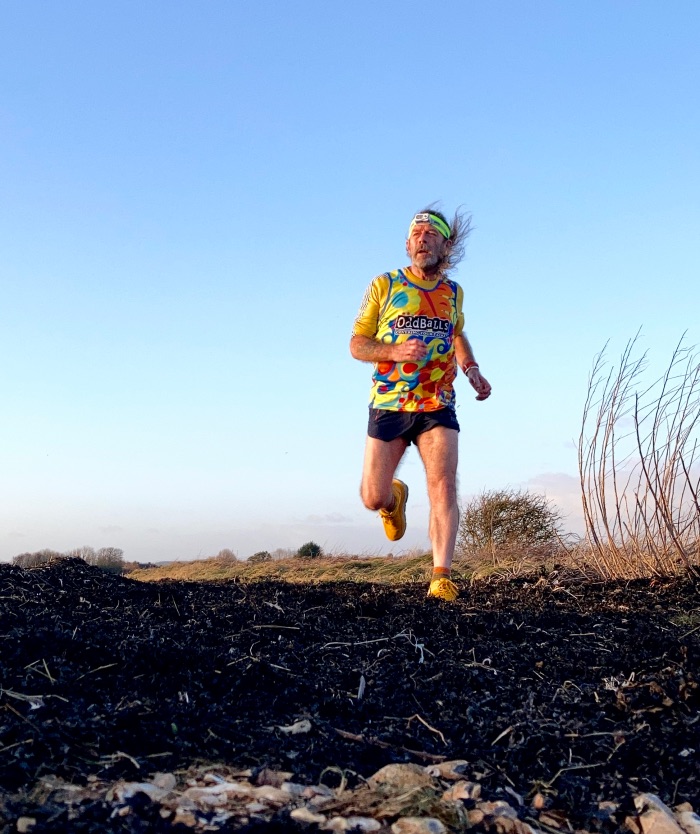
February found me deep in a mental misfortune on a scale I had never experienced. It was the strangest thing: physically I was very fit; but mentally I was in the middle of pyrotechnic confusion. I suffered long bouts of inertia after poor sleep and moments of anxiety, unbidden. A sunny day would pass by beyond my window and I could not step outside, apart from my run – usually a short one on such days. Yet, on grey, mentally draining, rainy days, full of sudden rage, I would throw myself out to run a fast 10 miles. I needed help, but I was waiting for that help to come to me. In my heart I knew I would have to act as there was little contact from my professional life. “Aye, there’s the rub…” once more. I needed positive mental energy for that.

To charge my battery, I looked at my recent running progress towards my June 100k. In February, although not focused on a strict schedule, I still ran every day and even managed to break a couple of my course records on longer runs. Also, I hit 100 miles once more, meaning that for 15 months in a row I had accumulated three-digit training miles – a new record. My running streak still stands and is now at 429 days. I am more than holding my 2021 fitness, so have a good base to focus on coming races, if I can get my mind better. I’ve pencilled in the Goodwood Marathon on 2nd April – I hope for a 4:25 there to show I can maintain a steady pace at longer distances.

Ultimately, I am Racing the Reaper Man to Ultra, but have yet to structure my training properly. It took February to show me I needed to become proactive in seeking help – waiting for help was doing me no good. I needed my mind back to its strongest. Thus, I made the decision to start some CBT (Cognitive Behavioural Therapy). The spark I needed came in the form of Ukraine’s brave resistance to Putin’s invasion. It showed me that, when the chips are down, you have to fight – so I acted before I could be overtaken by symptomatic apathy and inertia. The call, answered by a great chap called Jordan, was the best move I’ve ever made. From that 45 minute call, I felt in control at last.
Cognitive Behavioural Therapy – an overview
CBT is based on the concept that your thoughts, feelings, physical sensations and actions are interconnected, and that negative thoughts and feelings can trap you in a vicious cycle. (This is indeed where I have been trapped.) It aims to help one deal with overwhelming problems in a more positive way by breaking them down into smaller parts by being shown how to change these negative patterns to improve the way you feel. The proactive and dynamic thing for me is that, unlike some other talking treatments, CBT deals with one’s current problems, rather than focusing on issues from the past. It will give me the ability to identify practical ways to improve my state of mind on a daily basis, and structure a long-term strategy to manage any future pressures.
I’m afraid, as a male, I have seen this route as a sign of weakness in the past. This is common enough, but my Racing the Reaper Man Year proved to me I am not weak. At 65 I am in good order, have nothing to be embarrassed about and I have come to understand fully the unbreakable link between body and mind. I can now view CBT as an injury recovery program. I will write up the affect it has in my next blog post, reflecting Seneca’s words, I hope.
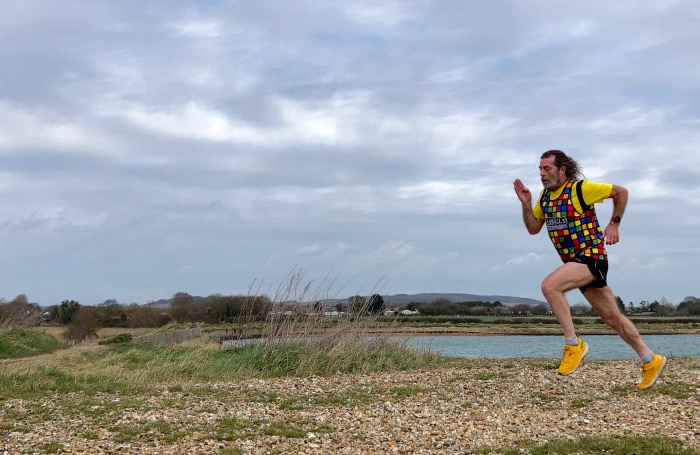
In the meantime I intend to use March as the start of my structured training, with a focus on core strength with Martin Sorenson, and longer runs with some speed work. It is also time to record a full set of stats so I can see exactly where I am. The ones I do have for February are as follows:
- Daily calorie balance 1763 kcal
- VO2 Max average 45
- Average resting pulse 49 bpm
- Total miles 100
Racing the Reaper Man to Ultra: March 2022
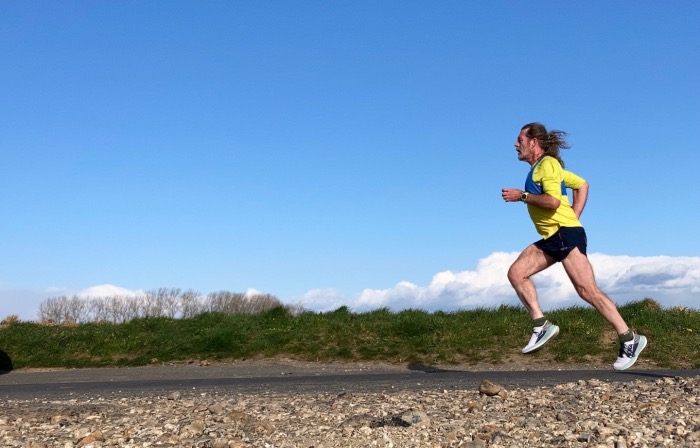
February ended with Russia’s invasion of Ukraine, which coincided with the lowest point of my mental exhaustion. I had been unable to break the cycle of slight improvement, followed by several days of depressed inertia. Rather like Sisyphus, I was in what seemed to be an unending labour, with no hope of release. But, of course, reality takes hold and time does not stop. One reaches the point where even doing nothing is hard work – then there is yet another day to face. I knew my life would continue, so what to do? I wrote some time back that, ‘I gave up once, and nobody noticed.’ In the end, no matter what help there is, one has to take that first of many steps to recovery. After all, what is the alternative? The answer to that is misery. And that misery can be many things, but will be self-perpetuating. Choice always remains.
My illness is fully work-induced. That was a truth I had to accept. Without the expected support, it was up to me to become proactive and take control. After all, I had applied this to my physical being successfully enough, so why not with my mind? In early February, that seemed like a step too much, but by the end of the month I found the help I needed with the start of CBT which is allowing me to step back and rationalise my anxieties. In that one proactive step, a spark of life entered my mental battery. By the first week in March I could see my constant training had kept me very fit, so once my mind started its long road back to recovery, the vehicle it travelled in would be very reliable.
I took stock and noticed a few things that had become helpful or unhelpful habits since last December. This month I started to address each aspect to increase positivity. I will cover them here.
Running
Without doubt, running has been my saviour, right through the various pandemic lockdowns as well as throughout my illness. Last year I maintained basic tenets to reduce my weight and increase my fitness: keeping my balance of calories below 2000; running every day; maintaining my mainly plant-based diet; keeping my monthly running total at 100 miles or more; and having regular core workouts. This had become a habit to the point where I would stick to these targets without much thought. It became my normal way of being. Thus, once I was suffering from burnout, I automatically kept to this baseline. Even at times of absolute hopelessness, this kept me moving. Running, indeed all exercise is the best therapy in the long term. It is a moment of taking control.

In March I started to train properly with a focus on the 100k. The results are summarised at the end of this blog post.
Getting out
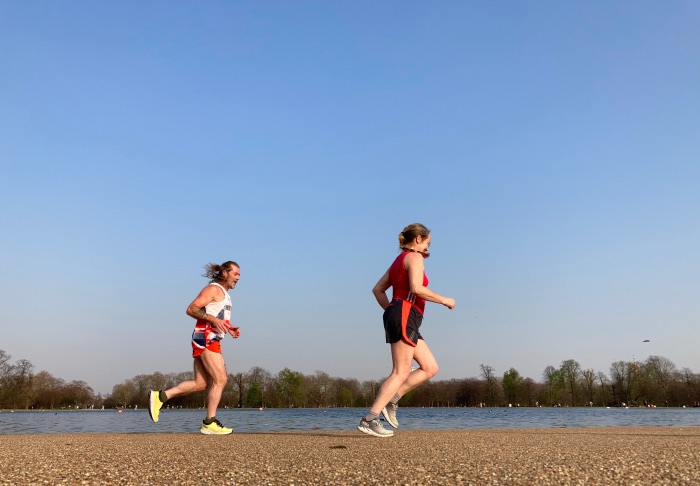
One of the main symptoms of my burnout was only leaving the house to run or shop. After the huge, emotionally draining journey to Scotland, over Christmas, I had become semi-reclusive. Yes, I ran every day, but that was solo and mainly on trails where few people would be met. Whilst shopping I always wear a mask – there is now a learnt stand-away-from-others in society, so I remained isolated. Thus, whilst reflecting, I knew I had to start getting out more, not just for necessity. With the CBT sessions helping me to set strategy, I decided to make a couple journeys to get used to being in the greater world. One to Somerset where I set a new course record on a local route I’d used many years ago. Then, later in the month a trip to London, staying the night in Kensington. My Passepartout and I ran in Hyde Park and Kensington Gardens, and the trip made me tired, but much less anxious. Little trips away from home were helping my mind adjust to a more proactive future.
Imposter syndrome – the fear of authority
Imposter Syndrome has been written about by greater minds than mine (sic). In my case, being self-educated in most important areas of life, I never had the confirmation of achievement by a father or higher educational establishment. My childhood had been dominated by Christian brutality at its worst, so I had been programmed early on to ‘fear’ authority. I am free of any faith-based twaddle now, but still have that deep-set programming. I have never fully dealt with this, so I’m using CBT to lance that boil. As I recover I am taking charge of my return to my career, rather than waiting for ‘authority’ to lend a hand. They have not in 5 months, so ‘authority’ has become of no meaning for me. I am building this in the most positive way – firm, fair and proactive. In March I applied this fully and have started to regain control of all aspects of my life. After all, fear is only about what may happen – and the variables are astronomically high. Thus, proactivity becomes the key in steering strategy in the way best suited to oneself.
Rage and its positive effects
I survived a cruel childhood. The details are not important here, but it was life-changing. Fear is a terrible thing for any child to live with. In later life this can manifest in many ways, both positive and negative, but it can define one’s future growth. My way of surviving was to develop a ‘rage battery’. I discovered that physical pain can be endured, so gradually I found an armour. My rage battery overcame pain. It remains my ‘impulse power’, (to use a Trekky metaphor). Even at my lowest, this source of energy gave me belief that I would recover, get stronger and overcome the odds. Giving in to violent rage is not good, but to channel it into intellect and cognitive function has served me well.
Fear of statistics – belief in oneself
Just like maintaining good habits, it is easy to stop good habits. My Racing the Reaper Man Year gave me a positive routine. My abiding fear, or anxiety, was finding out that my formula would stop working. Reducing weight was almost straightforward, but would my philosophy and system maintain my final goal weight and statistics? From October I stopped taking weekly readings from my smart scales. Initially I did this on purpose to allow me to rest, but then the fear of what the scales would show took over. Then circumstances forced me to just about tick over until March, this month. I stepped on the scales on March 12th. I had convinced myself I would have ballooned in weight. Yet, there I was – 166.6lbs! Slightly up on my fully conditioned best of last year, but well below my original target. I had maintained a healthy weight by just living my Racing the Reaper Man philosophy! My belief returned, and with it more positivity to train properly.
Staying ahead of the Reaper Man – Choice
I set out choice as the main tenet of what we are. What one sees in a mirror or on the scales is a reflection of one’s choices – it is not an accident nor someone else’s fault. Thus, if one chooses to change a lifestyle to become a healthier, fitter and happier person, it will be done. I hope I am proving it. I have chosen to recover from burnout by understanding what happened and applying techniques to get through. I will now continue to build on my winter’s foundations and move towards my ultra in June with renewed belief. All that is left, is to regain the full health of my mind.
My March transition
CBT was allowing me to see a way of parcelling out each of my anxiety-creating issues, focusing on those that were not really so bad, and dealing with the immediate problems. It was interesting to find out I seem to be suffering from a type of PTSD, brought on by the work-induced pressure I had endured. On March 19th my world turned to Technicolor… after 16 weeks of floundering through the effects of mental illness, I finally reached a point where I knew I was on the way back.
The day was bright and sunny. Mentally, I still had the daily challenge of getting out, so as I faced a 20-miler, with lots of hills, my focus had to be ramped up. I prepared and set out feeling heavy, tired, with a stiff right leg from core work. The hills were huge – I’d miscalculated the climbs on trails over Kingley Vale, got lost on a descent near West Stoke, and plodded lesser hills to the 10-mile mark wondering how I would get back.

Then, at 10½ miles I seemed to break through a barrier. The pain in my leg went, I felt good and, as I turned to see the huge return climb ahead, felt euphoric! A runner’s high? More than that. In that moment my anxieties looked smaller, I felt stronger and the world more beautiful. The climb back over the mighty Bow Hill was tough, but I was even moving quickly on the race-walking bits – those parts of a steep climb where running is near impossible. As I dropped down to the 16-mile point and took on a caffeine gel and an extra bottle of water (stashed earlier) I knew I would recover my mental health. The final miles clipped by at just over 10-minute miles and I got home having covered 20½ miles. Monstrous, marvellous and a defining moment in my year.
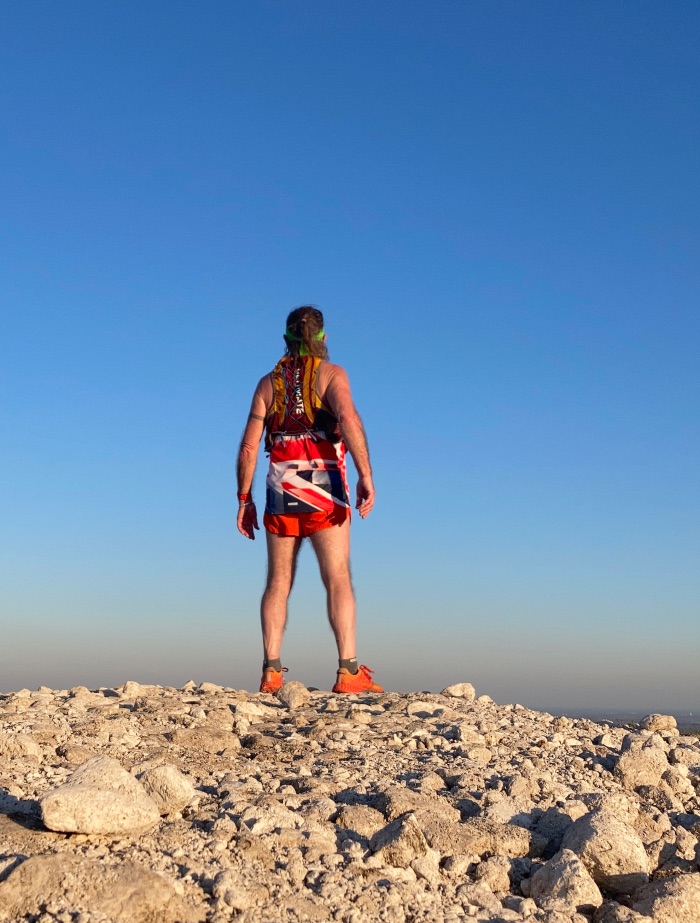
This route was easily the equivalent of a flat marathon. That evening I entered the Goodwood Marathon on 3rd April – it had been pencilled in as a training run for months. Now I felt I could use it as a training run without fear. I also firmed up a 32-mile multi-terrain training run for the end of April. The 100k in June seemed more attainable.
Delayed Onset Muscle Soreness (DOMS) would preclude any more longer runs up to the Marathon, but by the end of March I was just about right. Somehow, unbeknownst to me, I had got ahead of last year’s mileage. March was also my biggest mileage month for many, many years – 143 miles. All this without noticing – sticking to my basic philosophy had worked: just do the healthy things automatically when in doubt, then your physical fitness will be there to carry your healing mind when it’s needed.
To sum up March, I would use the word ‘transitional’. I had started taking control of smaller things; this in turn, helped me to have the confidence to take control of greater things.
A thought for the coming month
As you will know religion or blind faith in ideology is anathema to me. The introduction to my partly completed book, Racing the Reaper Man, has this passage in its Introduction:
‘Although I can become philosophical, I am also a stepper-backer. I have found that most debates forever shrink as they focus on the specks of irritation, rather than a logical, progressive overview. Politics, religion and social media are the greatest subjects for speck-focussing, and life can seem like a series of screaming strap-lines as a result. A statement is not factual without proof – proof is not true unless tested – tests are not certain unless repeatable. Opinions are generally strap-lines for lazy thinkers. Humans naturally believe what they want, based on personal bias, so to look at improving one’s life, it becomes necessary to learn to step back. So, for this blog, and its future incarnation as a book, I will step back and write what I know about making life healthier, fitter and better for the more mature person.’
Ironically, I found a passage from the Chinese Taoist/philosophical text that I loved. It is from Chapter 38 of the Tao Te Ching:
‘When Tao is lost, there is goodness. When goodness is lost, there is kindness. When kindness is lost, there is justice. When justice is lost, there is ritual. Now ritual is the husk of faith and loyalty, the beginning of confusion.”
Let not ritual, for the sake of ritual, command our lives. Running is not ritual, it is like breathing, a necessity of life.
- Weight: 11st 10.2lbs
- Daily calorie balance: 1721kcal
- VO2 Max average: 44/45
- Average resting pulse: 49 bpm
- Total miles: 143 (biggest month for years)
- Unbroken running streak: 450 days
- Belly: 30½”
Racing the Reaper Man to Ultra: April 2022
April started with a Marathon. I had run the miles in March, but mentally I was still healing. So, I had two key issues to consider.
- Could I train through a marathon, without it being the focus, and would my speed-at-distance be even and sustainable?
- This was also a big test of my mental strength: could I cope with the nerves of competition, and with the crowds?
In the end, the Goodwood Marathon on Sunday 3rd April answered each of my questions and taught me far more than I had given thought to.
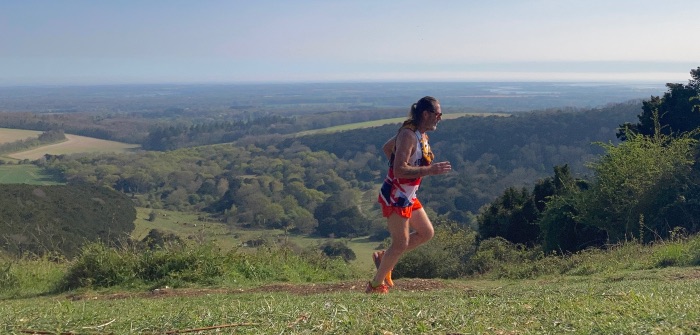
Marathon morning found me full of intense anxiety. Nerves before a race are quite normal, but on this morning I realised my illness had magnified everything. I almost went back to bed and hid. Luckily, my Passepartout was with me for the weekend, so I was calmed down, drove to the Goodwood motor racing circuit and immediately felt better. On a sunny, but very chilly morning, I wore a light T-shirt base layer underneath my Ukraine-flag vest, and warmed up with the others.
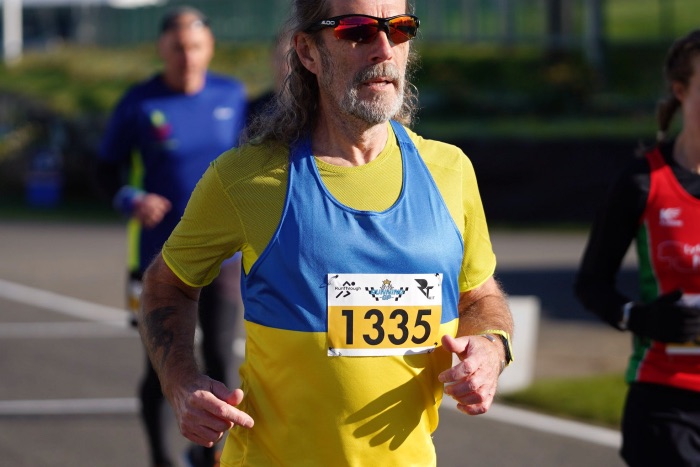
I started dead last but soon nipped past the tail-enders to clip out an 8:57 mile. Too fast. So, I eased back and relaxed. At 10 miles I was averaging 9:35s, and still averaging 9:38s at 20. I had set a target of under 4:27:00, but with a goal of 4:22:00 on a good day. After all, I was training through this event. Yet, at 20 miles in around 3:13:00, I did the maths and realised I could get under 4:20! I only had one wobble with a 23rd mile in 10:23, but rallied and was close to 10:00 for each of the rest. I finished strongly in a new veteran personal best of 4:15:44 (09:44 pace).
Stopping turned out to be the difficult bit – as an experiment I brought along my smart-scales. I stripped down to shorts, weighed myself, then, as I put my clean shoes on, nearly blacked out. Passepartout sat me against a sunny wall and dashed off to find a paramedic. My BP was 90/68, though my blood sugar was normal. After lots of hydration, lying me down and raising my legs I got back to normal and was able to drive home feeling none the worse for wear. I’m still not completely sure of the reason: dehydration; too much caffeine; or imbalance of electrolytes? My blood pressure has remained low, so I’m starting to think my medication for genetic high blood pressure may be in the frame. Perhaps my healthy lifestyle has brought my BP under control and my medication needs reducing?… I will keep an eye on things and talk to my GP.
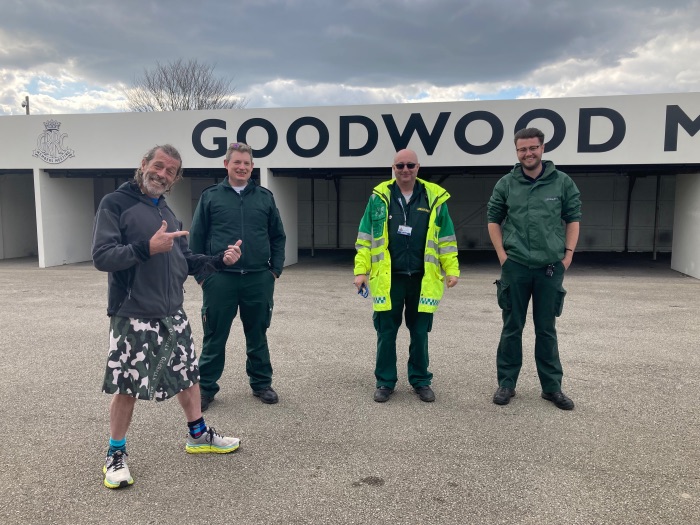
A good start to April. My CBT continued and my strategy to deal with anxiety was becoming more sound. Yet, I still have terrible flash-back dreams, normally brought on by having to deal with work-related issues. Brazenly quoting Seneca once more:
‘…some things torment us more than they ought; some torment us before they ought; and some torment us when they ought not to torment us at all. We are in the habit of exaggerating, or imagining, or anticipating, sorrow.’
This is what one’s injured mind must learn, or relearn. I am moving slowly down that road. My new aim is to initially confront my work-related stress, but to follow that up by dealing with any accumulated issues that I have pushed aside in that male-dominated macho way.
Spring proper arrived in April. With the sunshine my running seemed to improve a level. I never rested after the marathon, instead completed a 53-mile week which included a trail 11-miler, followed by a week with 3 long runs of 10, 10 and 14 miles.
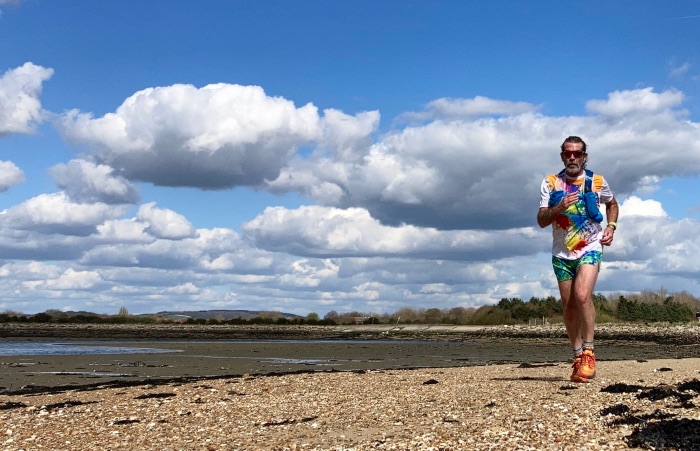
With the sunny weather I entered a kind of euphoria, running for the love of moving across the countryside, along trails and footpaths. Hills were enjoyed. Finally, after 4 months, my mind was healing. My legs were fine, except for an ongoing stiffness in the right one, and I could now picture me completing the 100k.
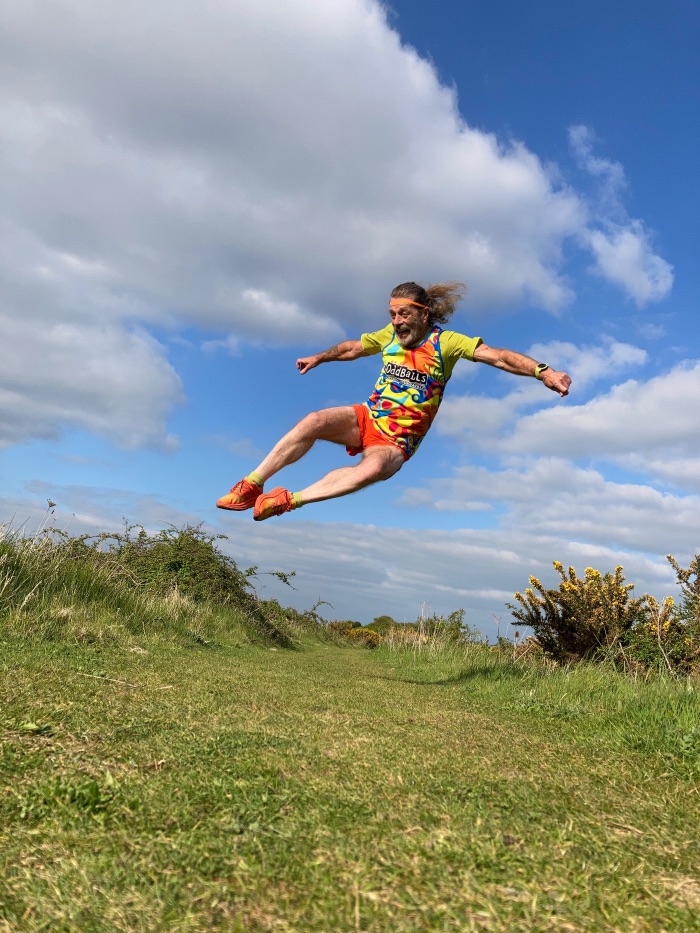
On 22nd to 24th I tested myself once more in a more crowded situation. I attended Burnham-on-Sea Book Festival as an invited author. It left me tired, but I coped well enough.

The remaining constants of my PTSD are extreme mental tiredness after formal, organised events, and regular flashback/‘flash-now’ vivid dreams. These latter wake me in a panic as they are so real, even to the point of feeling the wind on my face, smelling aromas and talking as they occur. That I may have to live with this is rather disturbing, but at least, once awake, the stultifying effect lasts only for a short time.
I eased back on my training after the first two big mileage weeks, ‘tapering’ towards a planned, hilly 32 miler on Wednesday 27th. I’d arranged to be supported by my Personal Trainer, Martin Sorenson and my Passepartout.
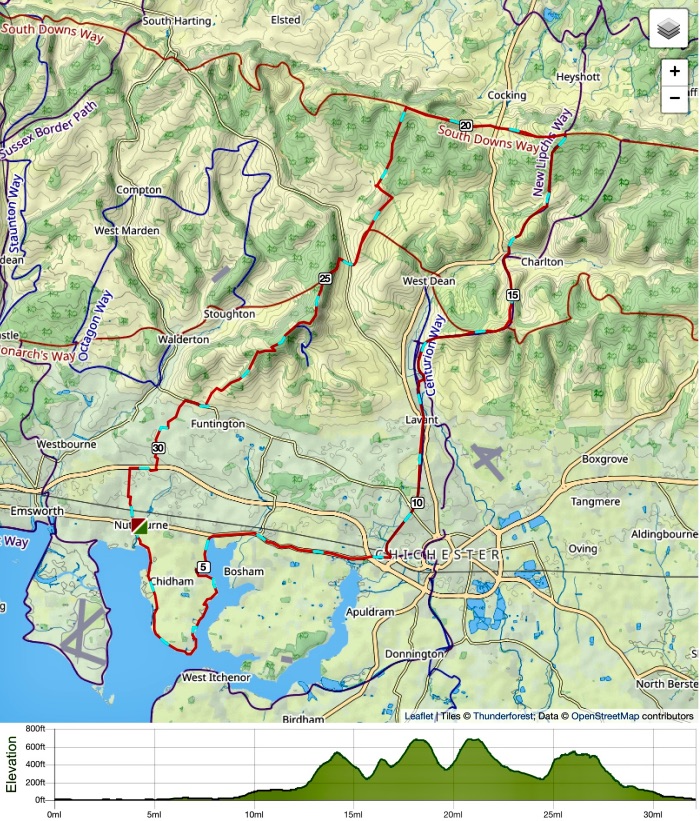
The course was mainly trails: an initial level 9 miles around the coast, along the road to Chichester, then up the Centurion Way where the climbs started. As I set out, my right leg started to give way slightly, and it held me back a little.
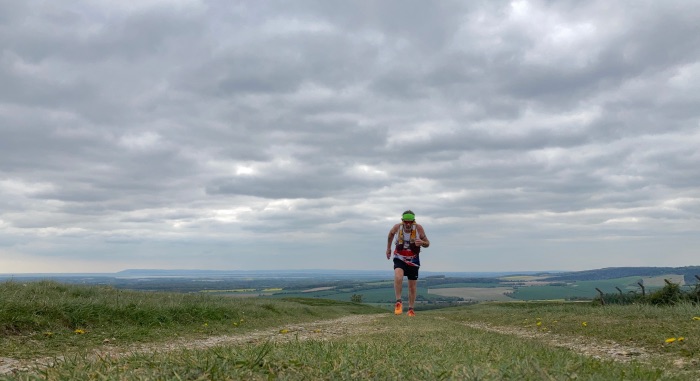
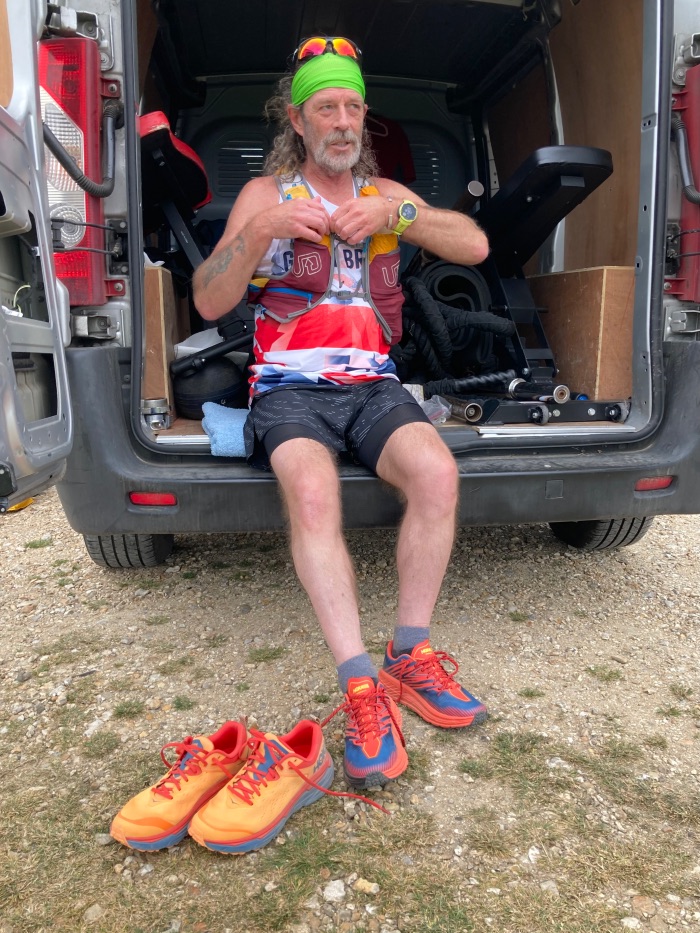
The first big climbs over Haye’s Down, then The Trundle emphasised the issue with my leg, but at 14 miles, in the car park below The Trundle, I felt fine and changed my Hoka ATR6s, to Hoka Speedgoat 4s for the hefty ascents ahead. I’d eaten some chews, but was instinctively relying on Tailwind – it was fuelling me perfectly.
The drop to Singleton was niggling my right leg, but I kept to a steady pace, climbing Levin Down, and passing halfway in good order. The huge climb through Singleton Forest made my leg go numb, but sections of race-walking kept me going. I dropped down to my crew at 19 miles at below 9 minute mile pace, the pain going on tarmacked ground. I filled up with Tailwind, then climbed a mile onto Cocking Down (fabulous name), chased a couple of hares, then dropped to Chilmark, my leg hating the downhills by going all wobbly.
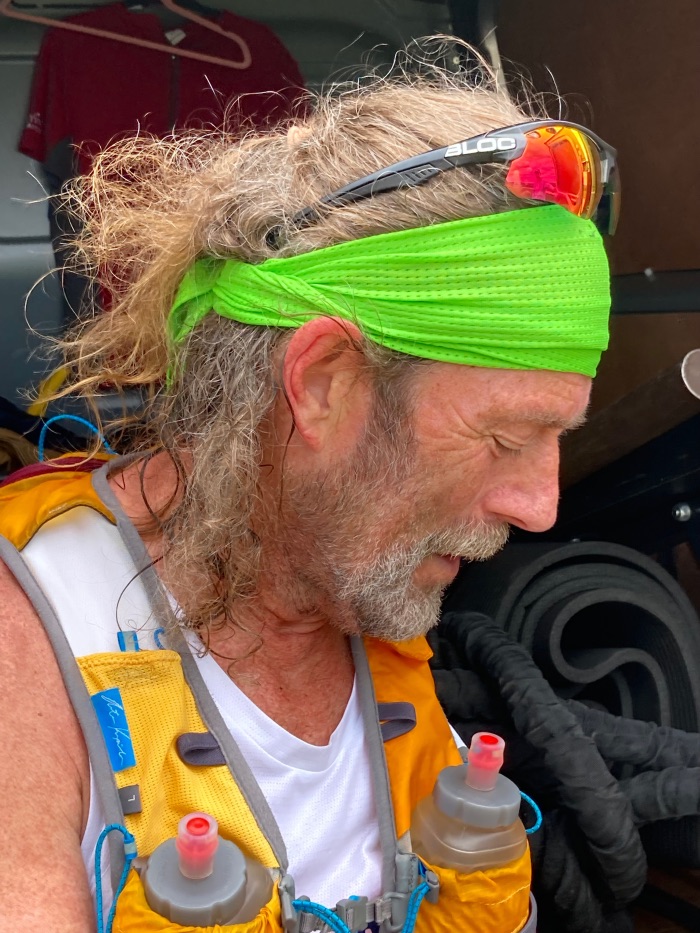
I left my crew at 23 miles, clipping along at 10:40 pace, but cringed at the huge, steep climb over Bow Hill to the Devil’s Humps above Kingley Vale. I was very pissed off as, apart from my right leg, everything was fine, and I hit to the top of the southernmost Devil’s Hump at exactly 26 miles.

Down, down I dropped to Adsdean, met the crew again, but just wanted to carry on as I was fine. I arrived home after 32 miles in good order, in around 6:40:00, perhaps averaging 12:30 a mile. My leg had cost me half a hour, but it wasn’t a severe injury. I was happy with the day, felt very good, just a bit tired. My weight was the same as when I started! Frequent pissing in hedges showed my hydration was right. A small blister on my left, second toe indicates the need of some judicious taping, and I should have used poles on the big climbs – lessons learnt.
Subsequently, I found out the obvious. My Iliotibial Band down my right leg had been niggling since last October. So, I found a series of 5 exercises to perform daily, and the improvement was immediate. I jogged a mile the day after the 32, then ran a coastal 4¾ miler and felt fine, just lacking speed. I ended the month with a big 170 miles in total, and had successfully trained through a marathon and a purposely brutal 32 miler, my longest ever run. I still look at June’s 100k in a state of awe, but I should be physically ready for the challenge. That I will be testing my mental strength to new limits, is exciting, to say the least.

The biggest thing in April was my progress to mental health recovery. I have a strategy to resume work on 1st June – a phased return – and will approach my high pressure job as a changed man. My fear of authority has gone. My self belief is stronger and my will to get wrongs corrected is in place. I have set a date for my retirement next year, so in that time will be working to give my team a stronger foundation, succession plan and a strategy for a resilient future.
However, until then I have May to get through. I’m now well enough to take a holiday. Not from running, just from my cocoon of safety, my home. Time to test myself 1600 miles away, run on some hot, hilly trails and recharge my healing mind completely. Racing the Reaper Man is a lifelong commitment to which I intend to stick. The alternative is mediocrity, beigeness, stultifying comfort and misery. Onwards into May and my adventures on ancient Ikos…
April selected statistics
- Weight: 11st 9.8 lbs
- Daily calorie balance: 1574 kcal
- VO2 Max average: 44/43 (Garmin seems to adjust down with age…)
- Average resting pulse: 49 bpm
- Total miles: 170 (biggest month for years)
- Unbroken running streak: 490 days
- Belly: 30½”
- Typical blood pressure: 121/66 (my lowest readings since hypertension was diagnosed)
Racing the Reaper Man to Ultra: May 2022

After rounding off April with a 170 mile total mileage, I entered May planning to maintain my fitness on my first real break since I became ill. I was testing my improving mental health by flying away from my safe cocoon, my home, to ancient Ikos, the final resting place of Achilles’ father, Peleus. The modern name of this fabulous island is Alónnisos, jewel of the Northern Sporades, floating in the wine-dark Aegean Sea. With the 100k looming on 11th June, I had to get the balance right.
The only thing preying on my mind, was the continuing issue with my right leg. I knew I’d carried this problem with me through the winter, and it was getting steadily worse. Looking back at my diary for last October’s 50k, I could see the start of it where I noted:
‘My right hamstring had been tight behind my knee joint, so, even as I settled into 10:10 pace, I was far from happy.’
As my mileage increased, the more the leg was either giving way, or going numb. During last month’s 32 miler, it had really hampered me, so I was hoping a month of careful, lower distance runs would get me through. But, as we know, hope is not an answer – it is the last thing to do, after training and fixing injuries.
Travel day was long. We had to kill 6 hours in Skiathos Town waiting for a rescheduled hydrofoil, the Flying Dolphin, so we parked our bags at the Sol Levante Taverna and pottered about until the final half-hour. There was a 400m walk to the Flying Dolphin pickup point. Passepartout had a bad shoulder, so I carried both non-wheeled expedition bags, banging one into my right knee many times. I thought nothing of it. We arrived at Patitiri, had a mile run, then drifted into Old Ikos.
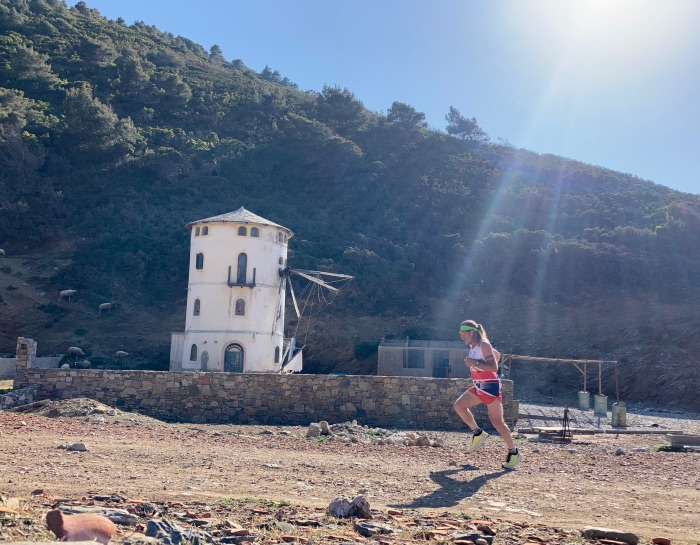
I ran well in the first two weeks, but my right knee started to swell! A bruise was evident – I’d damaged it in Skiathos (time to buy travel bags with wheels!) Alónnisos is a great island, though there is very little flat ground. My plan was to make the most of the hills and trails, peaking with a 10-miler in the final week and carrying my strength with me to the 100k. The first week was a slow build up with a 6-miler over very steep ground being the biggest run. I was so strong on the hills, but my knee was stiff and my right ankle was giving out on the downhills. The second week was 26 miles of hot, rugged trails, including a circuit of 7 miles taking in the notorious Killer Hill of the Alónnisos Challenge 31k, which I’d run in 2018. Again, I was strong on the hills, but my leg and knee were no better, even with some remedial exercises and cooling in the kiddie’s pool. I was in trouble.
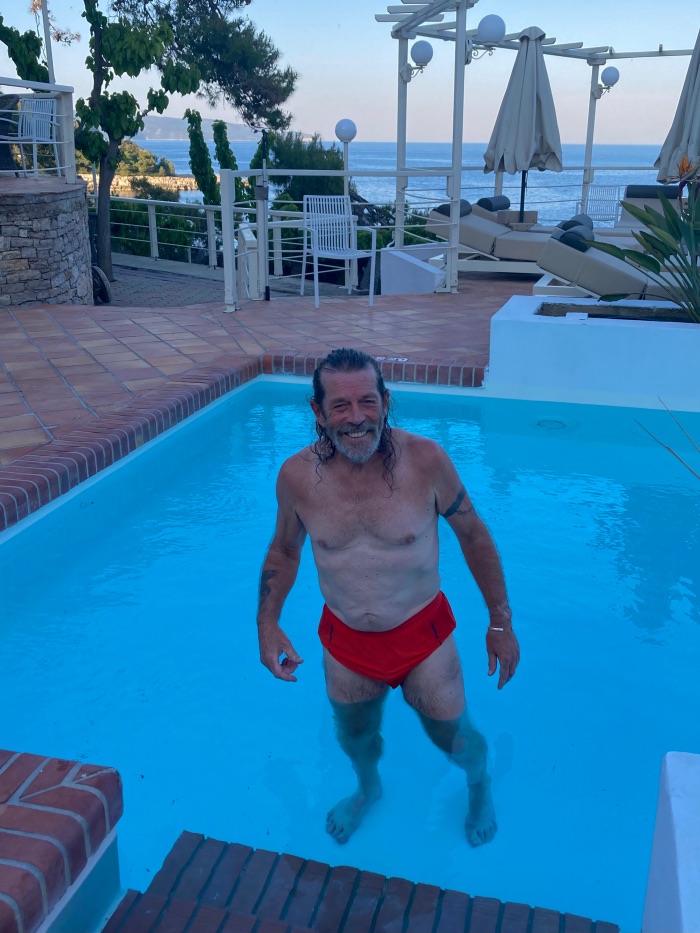
By the third week I’d decided that I needed to reduce my mileage to my version of ‘resting’. Apart from my 40th anniversary of logged running, when I managed a big 4 miler up the huge climb to the Chora threshing circles and back, I dropped my other runs to a mile a day. We found relatively level ground at the defunct reservoir, a circuit of which is a mile – perfect, and a fabulous place to watch birds at the same time. Even so, we had also been walking between 20 and 27 hilly miles a week, so my leg was far from being rested. I got home knowing that my Race to the King 100k was becoming more of a burden to carry.
Once home, I started to ice and compress my knee, which finally showed signs of healing. I’d invested in a gel pack I can keep in the freezer, a brilliant piece of kit. On the last Wednesday of the month, I had a heart-to-heart with my PT, Martin Sorenson, who pointed me to a local sports physiotherapist, Ricky Lidbeater of Livebetter Physiotherapy. I was fitted in to his busy schedule on the following Saturday and met a really great professional, and nice chap. The prognosis was not damning, but roughly as follows:
- My knee injury was separate to my other leg issue – the blows I’d suffered made it swell, this being the knee’s natural way of protecting damaged tissue. With ‘rest’ ice and compression it would heal.
The issue with my right leg was the product of two things:
- My lower back was tight on the right side, impacting my nerve that referred pain through my glute to the hamstring behind my knee – the original injury. This was cutting off the signal to my muscles to say ‘run’, on occasion, thus the odd giving way feeling in my leg.
- This was being exacerbated by a very tight right calf, leading to a swollen Achilles. These two issues were feeding off each other, so were not getting better, and the whole thing would be magnified on rough trails, particularly downhills.
I knew I could probably coax my leg over 50k, but by then I’d be pretty crippled – in the 100k, with the hills over the second half, I would probably damage myself beyond logic, and probably DNF. Ricky said it would be unwise to run it. On the plus side, I was given exercises to carry out, instructions to follow and also I could continue running, as long as I didn’t go beyond 10 miles, and that only occasionally. I quickly made up my mind to withdraw from the 100k and get fully fixed and fit.
After some pretty deep, but impressive massage on key areas, I was sent on my way feeling much better. The beast was off my back. Ricky and Martin would devise a weekly program for my regular session and, in between times, I would be doing various calf raises, foam rolling and icing to ease my calf, reduce the pressure on my Achilles and get fully fixed.

My running streak reached an unbroken 521 days by the end of the month, and by not being very sensible, just stubborn, I put in enough miles to get to 100 for May, and to make 18 months at or above three figures – another parallel streak. I was already planning some autumn ultras, but for the time being would be wiser with my 65-year-old body. After all, there are no spare parts for this 1956 model, so servicing is the only option.
May was also the month I had to prepare myself for returning to the workplace. The big day is 1st June. I’m still not sleeping too well, and still get terrible dreams, PTSD style. It is a difficult mental illness to come to terms with, but I will overcome it all. I can honestly say I have never been happier than on a few of the days with my Passepartout on Alónnisos and since. Real big, happy days. A happiness I’ve not felt since I was 5 or 6. This shows me the CBT sessions are working – that I’m having a further series shows how poorly I’d been. I also know this should never have happened to me, so I will be rectifying the root cause. The Alónnisos trip showed I could cope with crowded settings, for a while at least, but I still get tired after intense events.
‘Coping mechanism’ – I’ve reached the point where I no longer want to ‘cope’ with recurring mental issues, including those from childhood. You see, I don’t get depressed, in the pure sense of the word, but suffer from extreme anxiety. It is this anxiety that is hard to carry, long term. Thus, instead of coping, I have started to ‘deal’ with it. That means, to me, excising the root cause and leaving it behind. We tend to voluntarily carry our historic hurts, sleights, grief and sadness with us. Instead of memories, they become barriers to freeing emotions. All religion, ideology, politics, strictly set tenets and biases are like this – they blinker one’s logic. So, for me, those moments of absolute happiness are a sure sign I am finally breaking my own barriers.
So, I’m still Racing the Reaper Man to Ultra, but the next big races are a little further down the line. In the meantime, I’m getting new knowledge about injury recovery – something else that will go into Racing the Reaper Man. If I’m lucky, I can show early decisions about recovery over bulling through races, can make a huge difference to longevity. After all, older age should mean a gathering and application of learnt wisdom, not a repetition of youthful mistakes. I will now start pulling the book together, set up the required chapters and start writing in earnest.
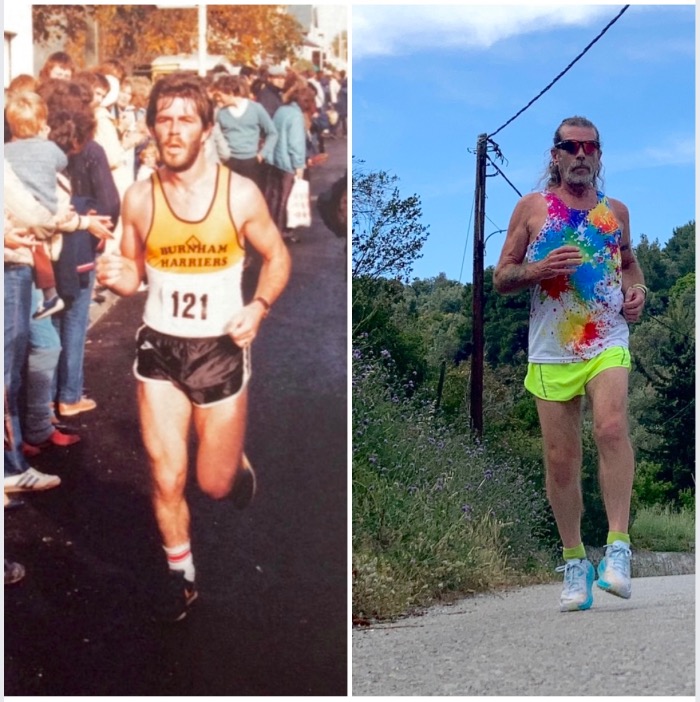
May selected statistics
- Weight: 11st 11.6 lbs (up a little, but still very stable)
- Daily calorie balance: 1974 kcal – my highest since I started this. Care of holiday and lower mileage.
- VO2 Max average: 43 (Garmin continues to adjust down with age…)
- Average resting pulse: 51 bpm – red wine in Greece has raised it a bit.
- Total miles: 100 (stubbornly getting to the ton is my minimum, if I can.)
- Unbroken running streak: 521 days
- Belly: 30½”
June’s Blog post can be found here and is also the start of a new page: Racing the Reaper Man Forever
In February 2025, 34 months later, my journey to Ultra resumes…
Racing the Reaper Man to Ultra: How do you run a 100k?
Recap, 27th April 2022…
…Up ahead I could see the long climb to the top of the South Downs. The Reaper Man was well behind me now, but my right leg had decided to give him a chance. This was not new – I’d been ignoring the injury’s effects for more than a year.
I’d already covered 15 miles from the coastal trails at Nutbourne, up the Centurion Way, over the Trundle and down to my crew – my Passepartout (now wife, Ange) and my great pal and Personal Trainer, Martin Sorenson. A quick change of shoes, from Hoka ATRs to Speedgoats, a refill of Tailwind, and on the trails to Singleton. My body was fit. Heart and lungs and muscles fine. You see, I’d decided that strengthening the muscles around the injury would nullify it. A brilliant concept – what could possibly go wrong?!
Just three weeks before this 32-mile training run, I’d completed a 4:15 marathon at Goodwood. I was in good shape for a 66-year-old veteran, running faster than all but one stalwart above the V50 category. However, I knew I could have been faster – my right leg had kept giving way… What an odd position to be in. My fittest ever, in real terms, yet carrying a long-term, chronic injury which was not quite going away.
Beyond Singleton the big climbs lay waiting. I’d deliberately placed the hard trails in the second half of the route to simulate my goal – the Race to the King 100k. Levin Down was the first test – my right leg started to give way again. This was the odd thing, I had no real pain, except my Achilles – which I thought was normal for a runner of my age, by the way. My leg would just briefly disappear from my brain’s circuitry. Then, I was okay again.
I was now going uphill through the Singleton Forest, having to resort to race walking in deference to my leg, cresting the hill of Heyshott Down somewhat bewildered, having covered the mile in over 15 minutes. I turned west, and ran down to my crew at the Hilltop car park, covering the ground below 9-minutes a mile. I felt great. I’d covered 19 miles and felt full of running. Yet, it was here I began to realise my strategy of shoring up an injury and ignoring it was reaching a predictable conclusion.
Leaving my Crew, I scaled Cocking Down, then turned to race downhill to just beyond Staple Ash Farm. This is where the full impact of the injury finally hit me. I couldn’t run downhill on rough trails. My right leg was numb and my foot seemed detached. It wouldn’t land securely on the uneven ground. By the time I’d reached my Crew, I was crestfallen. I stretched and limbered up, then headed on, running at a reasonable 10-minute mile pace on the smooth, tarmacked surface, wondering how I could feel so full of running, yet be breaking down at the same time.
My resurgence lasted until the brutal climb up Stoughton Down and over Bow Hill to the Devil’s Humps at Kingley Vale. My Garmin showed exactly 26 miles at this high point. It was mainly downhill to the coast from here. My leg was no longer mine to control, and no matter how well I felt, my journey to race 100km came to a crushing halt as I bimbled home. I’d covered the 32 miles at an average of 12:45 minutes per mile, practically one-legged. Pretty good, considering my age and the tough route I’d chosen, but I knew it was over. It was time to face facts – I needed to rest, repair and recover, no matter how long it took. I dropped out of the Race to the King shortly after.
At the same moment, I’d lost the final chapter of my coming book, Racing the Reaper Man – A guide for the long run. More of that later.

34 months later…
Sometimes life gets in the way of living. From that 32-miler in April 2022, to the time of writing, February 2025, my world changed completely. The only thing related to running was, I finally listened to Ricky Leadbetter, my brilliant physio, and let my body repair. Everything else was a rollercoaster of extremes.
I’m 69 years old later this year. How the hell that happened is beyond me. I was 18, blinked and 50 years disappeared! I’m sure most of us above 60 (or even 30, 40 or 50) will know that feeling. We often look back at old photographs and wonder how we got to our now. Well, that is time. From then until now, is time travel. And there’s the rub – it is a continuous forward journey along a varied trail of highs, lows, hell and high water. From those pictures in dusty albums, or instantly posted pictures on social media we tend to grin through reality, giving the idea that happiness is constant. We tend not to project sadness, heartbreak and fear. Uncertainty is avoided. The only certain thing, however, is that our long run through life will not end well. Fear not, it doesn’t have to be that way on our journey. Being knocked down is inevitable, at times, it is our response to the travails of life that is important. Let me explain…
My own view comes from 68 years of living life’s journey. I’m a rebel. Not in the rootin’, tootin’ hollerin’ way, but against the way society and culture inflicts faux reality upon us. I hate imposed lifestyle models. I despise the imposition of ideology, mythology and the new tendency for our species to embrace a type of self-imposed dementia, driven by begrudgers with instant access to that intellect-challenging drain, social media. Conversely, I love the way social media can be used to bring colour, hope and humanity to our lives. As a tool, it can be used beautifully, or can be weaponised. It is the minds behind its use that determines what you are, and what you will become. Without learning, adjusting and setting positive waypoints ahead, it is possible to become the living dead by stopping, withering and waiting to kark it. Thus, I rebel against self-imposed stupidly, dogma and age-based defeatism.
My last 34 months have been a lifetime in themselves. I will be as candid as I can be, here, as my aim is to throw a light onto how real life is multidimensional and that behind every snapshot in time, is a person on that roller coaster. To reach February 2025, the following events befell me:
- Burnout wrecked my mental health, leaving me with agoraphobia, PTSD and a damaged immune system.
- There was one moment when suicide seemed the only option.
- I have had to fight to expose hidden breaches of law against a large government organisation, which has taken 3-years to be accepted and acted upon.
- The affect on my immune system was catastrophic, and meant I contracted a virus every couple months up until the end of 2024.
- I’ve had severe prostatitis – at first diagnosed as cancer.
- I’ve undergone a colonoscopy and waited for 3 months to know if I’d developed cancer.
- I’ve had skin cancer removed from my chest.
- It took 18 months to recover from a long-term injury.
As I waded through this, the following happened:
- My sister-in-law died and my brother was hospitalised.
- My son was in a coma for a week.
- He died the following year.
More positively:
- I retired.
- I married my Passepartout.
- I’ve recovered from injury.
- I’ve entered a 50k in April.
- I’ve entered a 100k in June.
My reason for laying this out before you, is that I want to show that life can be brutal, aging can increase our travails, but if we choose, we can still live life to the full. I’m no more special than any other human. What I can get through, anyone can. Grief, joy, sorrow and laughter are all pieces of the jigsaw that make us what we are. How could I deal with so many new sorrows? I found advice, no matter how well meant, differed alarmingly from one source to the next. So, being me, I decided to figure things out for myself. I aim to share this with you.
Friday 28th February 2025
… after covering the 5½ miles of mixed terrain from home, I reach West Stoke. I turn and start the big climb to Stoke Clump. The seemly gentle slope is relentless, but I keep running with short strides, ignoring the urge to deploy my carbon fibre poles, strapped to my pack. The climb becomes severe in places, so I race-walk and run as the effort levels demands. Over the top and the wooded bowl of Kingley Vale is before me, but it is skirted by my old nemesis, Bow Hill.
I run down the muddy trail then start up the ever-steepening slope of Bow Hill. I deploy my poles – the first time I’ve used them in anger. I’m now 7 miles out on this brutal run, my legs are strong, but tired and my confidence is low. I race-walk the insane bits, but reach the top to the place where, 34 months earlier, my leg was finally giving out. Yes, I’m panting like a steam train, but my legs are fine. I’m in the middle of my longest run since then – 14 miles of trails and hills. I’m doing this a couple weeks earlier than I’d scheduled, but I was never patient, so why not see what happens on this monster run? I’m not liking the poles, so fold them and return them to my pack.
I turn west and trot along the ridge to the Devil’s Humps, Bronze Age barrows overlooking the deep bowl of Kingley Vale. I’m 9 miles in and feeling bloody knackered, but solid. More trails and hills, then down the long haul through the woods to Adsdean. I’m lacking speed, but am well ahead of the pace I’m looking at for April’s 50k, and we’ll up on my projected 100k pace for my race in June. I cover the ground quicker across the lesser slopes and trails home, averaging 11:45 pace for the whole route.
I’m back! Finally, after so long, my body isn’t broken. Now all I have to do is get enough training into my legs to have a chance to finally start and finish the Race to the King. Making a come back at 68, after so much pain, requires a certain amount of eccentricity, bloody mindedness and, dare I say, unrequited desire.

So…
….how DO you run 100k? The immediate answer is, I have no idea! I’ve read every relevant ultramarathon book, watched scores of videos and scrolled the Interweb until my mind went blank. The fact is, you don’t know until you’ve completed one, as far as I can establish. Upon reflection, there is a certain insanity quotient involved. There has to be, hasn’t there?
Of course, I couldn’t leave it there, as I’m already fully signed and paid up to compete in this year’s Race to the King, so these next few posts will show you what I’m doing, why I’m doing it this way and the philosophy behind my endeavours. This newer series of blogs will finally lead to a book, which will contain nothing but the application of my own experience and lessons learnt, with no flannel. Before I can write it, I must first of all get through that 62.14 miles.
February Philosophy – Giving up is an option, but don’t…
I’m haunted by this verse from a poem by Philip Larkin, called The Old Fools:
What do they think has happened, the old fools,
To make them like this? Do they somehow suppose
It’s more grown-up when your mouth hangs open and drools,
And you keep on pissing yourself, and can’t remember
Who called this morning? Or that, if they only chose,
They could alter things back to when they danced all night,
Or went to their wedding, or sloped arms some September?
Or do they fancy there’s really been no change,
And they’ve always behaved as if they were crippled or tight,
Or sat through days of thin continuous dreaming
Watching light move? If they don’t (and they can’t), it’s strange:
Why aren’t they screaming?
Bloody hell, Larkin! He was a bit curmudgeonly in his later work. Yet, he had the habit of hitting a nail squarely on its head. To me, getting older is one thing, giving in to old age is another. Being 68 is something I had no experience of, until I got there, so, as I noted above, I’ve decided to work it out for myself.
For me, I cannot conform to giving in. I tried it once, and nobody noticed. If one is content to reach a perceived old age – this can be as young as 40, 50, or 60 – and become the culturally accepted elderly, so be it. By this, I mean:
- Acquiring the uniform of sensible clothes, figure disguising tops, and saggy-arsed trousers.
- Getting rounder, redder in the face and wearing one’s hair like everyone else.
- Getting louder about politics, shouting at the telly and being worked up by misunderstanding the word ‘Liberal’.
- Only reading things that supports one’s personal bias – regardless of it veracity.
- Shouting down anyone who threatens the norm.
- Hoping everything will be alright without working towards giving yourself a fighting chance.
- Using other people’s failures to justify one’s own inaction.
- Finding stairs daunting.
- Not trusting a fart.
If I find myself getting close to any of the above (apart from the very last item on the list), I would start screaming! Thanks, Mr. Larkin.
Becoming fit, being healthy and embracing exercise will change one’s life. With running, I’ve discovered that aging doesn’t mean giving up, but training smarter. After recovering from injury, I’ve adjusted my running mileage, added core strength and stretching exercises, and embraced recovery.
Yes, I’d been getting it wrong in some areas after I reached 60. Recovery is definitely key. After a period of heavy exercise – long runs, speed work, core sessions – what used to take one day to recover, might now take two or three. My muscles, joints, and connective tissues don’t bounce back as quickly, which means training has to adapt. It’s that old chestnut: listen to your body instead of blindly following rigid training plans.
So:
- First. Do add strength training. Muscle mass will naturally decline with age, but strengthening the core, arms and legs will mean it can be delayed, reversed even, to a point. Stronger limbs and stable joints will reduce injuries.
- Second, adjust your mileage and intensity wisely. Feel happy about inserting a lower mileage week during a half-marathon, full marathon or ultramarathon build-up. Focus on recovering after quality sessions such as tempo runs, hill workouts, and strategic long runs, to build endurance without overloading your body. (Cross-training can help keep one’s cardiovascular fitness high i.e. – cycling, swimming, or rowing etc.)
- Third. Yep, give your body more time to recover. Sleep becomes even more critical as you age—seven to nine hours of deep rest will make a massive difference in recovery, performance and energy levels.
- Lastly, with core work ensure mobility exercises are included. Inflexibility becomes more common with age, but stretching, foam rolling, and yoga can help keep joints and muscles elastic. A gentle warm up before a run, and good stretching session after a run will help avoid injury.
At 68 I’m not the same as I was when I first began running at 25. In those 43 years I’ve had to adjust, often learning the hard way, but even at my lowest never really given up.

How I’m training for 100k – January & February 2025
I’ve lost speed. Although my running streak remains intact, 1528 days and counting, my runs over the last couple years have been low key and low mileage. At 65 I was covering 50k at 10:15 per mile, and 5k in 25 minutes, but now, at 68 and post injury, I’m having to be patient. 100k is not about speed, but endurance of body and mind. Thus, I’m concentrating on strength and making sure my long runs are mainly on trails. Speed will follow.
So, in January I doubled my monthly mileage to 85, with 2 long runs of 10 miles. February’s mileage grew to 101 miles, culminating in that hefty 14. They were big hills, too. Every week I have a hard, one-hour core strength session with my great pal and Personal Trainer, Martin Sorenson. I follow this with a series of 60 metre sprints. These latter test my flexibility and power. If you’re in your 7th decade, there is a fine balance to attain if one is to attempt to run ultramarathons. Work-rest-recovery. Everything pivots on rest and recovery, before more hard work. My increased mileage has made me tired. I often don’t sleep well enough to recover. Then, the key runs become harder. Thus, I will work on sleep quality.
My aim in June’s 100k is to hit one of three goals. If everything goes wobbly, 16+ hours will be okay. If I stay in good order and run at the level I am now, sub-16 hours should be achievable. If I have the perfect day – let’s be brave and look at 14 hours, 59 minutes, 59 seconds.
How do you run 100k? A dear pal, Sarah, has already completed a couple of 100k races, including the Race to the King. Her answer to the question was a very accurate, “You don’t, you walk part of it!” Quite! In the end it’s just putting one foot in front of the other until it’s over. Giving up is always an option, but don’t…

Racing the Reaper Man to Ultra: 50k To Nowhere
Foreword:
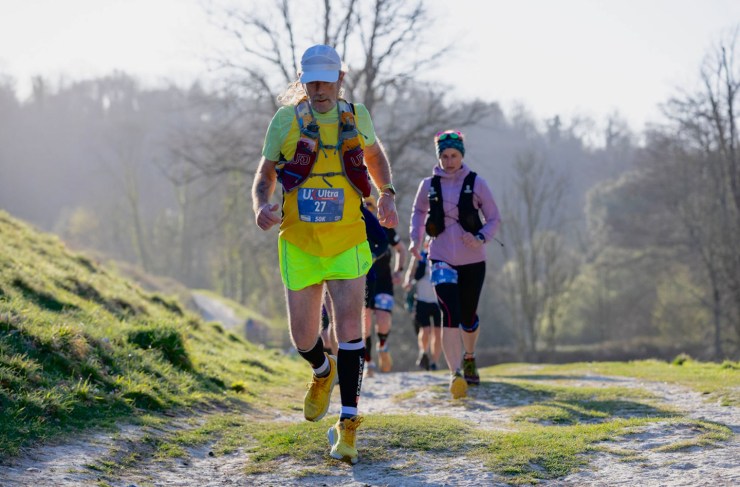
2025 turned into another year of heartbreak. The family have had to endure more painful losses. It has taken a while to feel right in sharing my Racing the Reaper Man experiences, for the last year. I’ve had so many lovely messages of support from people who are encouraged and helped by my own experiences, and getting through them, that I feel the time is right. Over the next few weeks I’ll bring things up to date, and also add to my Distant Harrier blogs. (January 2026)
50k to nowhere – Spring 2025
Life is not linear. It’s multifactorial with plenty of twists, turns and dead ends. As one gets older, there are more complexities, more events, more joys and more sadnesses to deal with. The journey to each of life’s goals is rarely a direct A to B. For me, over the last five years, I’ve gone from A and have stumbled down a hundred unexpected diversions, and have yet to reach B, T, or even Z. That’s why this blog is 8 months late.
I decided to publish this blog, largely written last spring, rather than scrapping it, as it has been my reality. I’m publishing it as I know a lot of people find that my openness encourages them to persevere. I’m publishing, as without it there would be gaps in the narration to that elusive 100k. It’s fine posting pictures of me running carefree, but that is just a snapshot of a life. On social media, we all tend to project a perfect, happy, edited life. If we’re not careful, it can disenfranchise a lot of people, our friends included. There is this tendency to show perfection. This false impression can depress those who think they are failing, in some way. Young and old. Racing the Reaper Man is not just about running. It’s about running as a part of life, and how life is multifaceted.
The one core value I adhere to is that everyday life is enhanced by exercise. For me, that is running, strength work and anything my physio sets out, should I need it. This vehicle, that is our body, our complete self, is the only one we’ll get. It needs looking after, maintaining and providing with the best fuels. I include one’s mind and emotions in this analogy – there is no separation biologically. Looking after oneself can instil resilience to get through hard times, even if you feel as low as it’s possible to feel. With such resilience born of proper care, our body will see us through life in good order. To show you how I’m moving forwards, here is my updated blog, first written in April 2025.
Oldism…
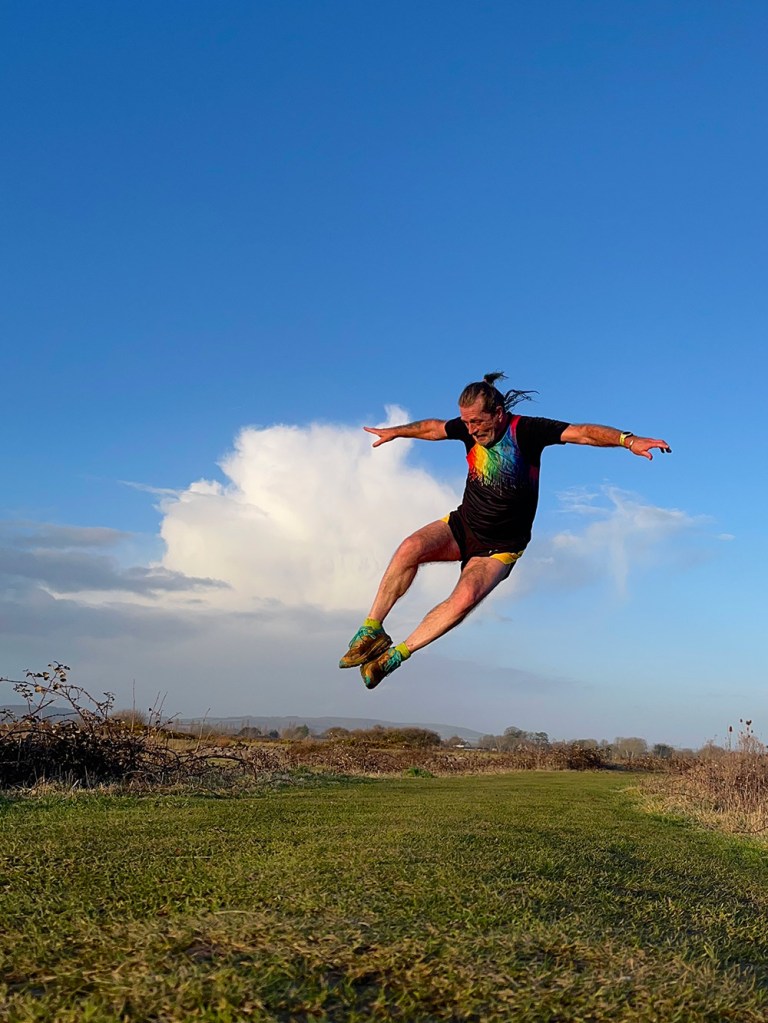
I’m 69. When I started running I was 25 and years of improvement lay ahead. Now, 44 years later, I really am Racing the Reaper Man. I find I’m fighting a rearguard action to keep cynicism and ‘oldism’ at bay…
…I’ll digress a little, to explain my own view of that number, 69. Oldism is my word for those who insist on conforming to the culturally accepted norms of aging. (Different to ageism.) There are lots of oldists about. The ‘act your age’ brigade, both young and old(ist). Oldism is the very practice and practise of criticising, using populist mores and derogatory sleights, to corral mature people into a bias-serving box. Even governments do this. The term ‘elderly’ is a broad brush. I’ve noticed, the worst oldists tend to be older, or prematurely older themselves. Oddly enough ‘gerascophobia’ abounds, too. This is roughly translated as fear of aging – often manifest when such sufferers grab for Botox, a plastic surgeon or a bucket of render to hide their laughter lines. There is phobophobia, too! A phobia about phobias – but that’s just silly.
Well, bollocks to that. I’m 69, not dead. Generally, I’ve looked after my body quite well, and have never been knocked down more times than I’ve got back to my feet. I had a spell of 8 years when I became overweight, ill and miserable. I’d invested in a relationship that suited neither of us. Moving on made more sense and saved my health. My life is precious to me – it’s the only one I’m getting, so I’ll bloody well look after it. No one else can. It doesn’t mean I’m trying to turn back time. Rather, I’m pushing the bounds and using it to my advantage.
The pandemic freed me, strange as it may seem. Working from home cured me of suits, short hair, London, and worrying about what people think. My ‘superiors’ hid whilst I was working 70 hours a week ensuring employees were safe from Covid-19, and only reappeared once there was praise to reap. It took me a while to figure this out. The Civil Service is full of wonderful people, but also steeped in elitist ‘don’t-rock-the-boat’ drivel. I was naïve enough to miss the signs that my integrity and honesty did not sit well. Only resilience saved my life, literally, and I started to fully embrace the things that freed me. Come retirement, I find I like who and where I am.
Don’t give in to the stereotype of ageing. Don’t think your limits are set in stone. Push the boundaries. That’s what the young do, and that’s what we all should do to keep healthy. The advantage of age is having a store of knowledge. If applied to life without bias, one acquires wisdom. Now I’ve found I have to apply everything I know to myself, as I undergo the next few months to big ultramarathons.
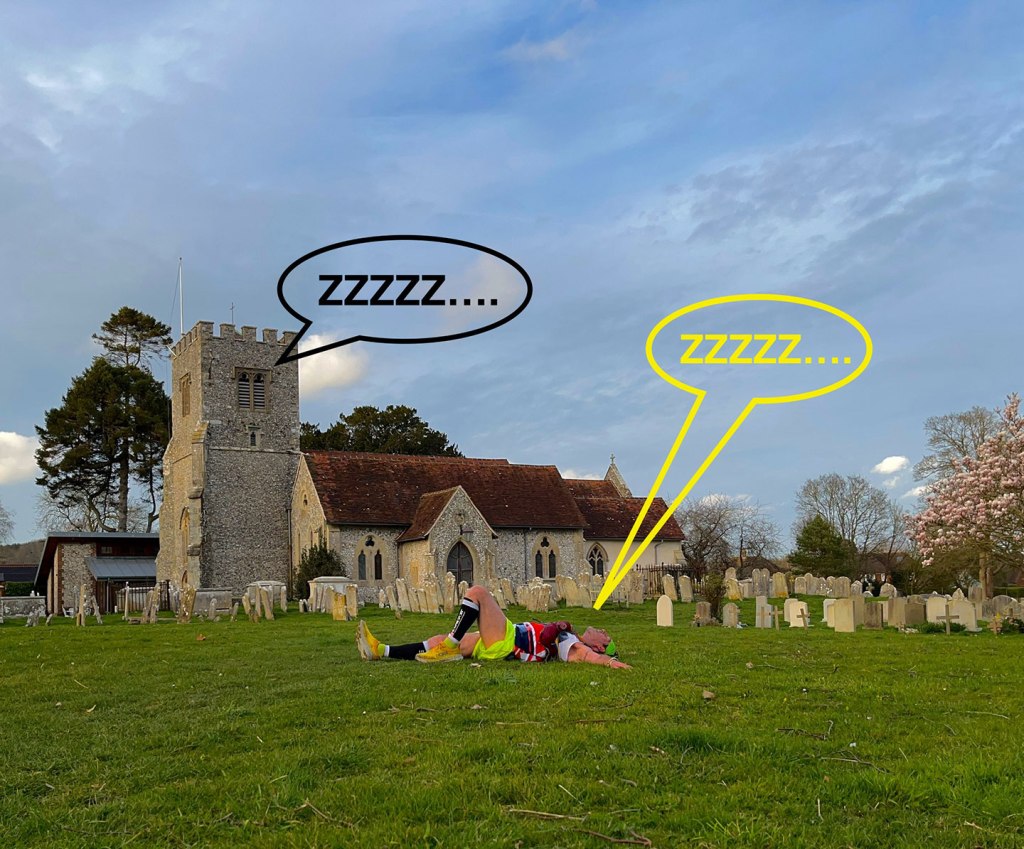
It was as I drifted into my 7th decade in 2016, that I realised I needed a new running challenge. Since the end of 2020, I’ve not missed a day of running. I hit 1800 days at the end of November. This streak started without planning. Each day without a rest became a whim, then a fancy and then a challenge. Now, especially with retirement, it’s more a way of life. Setting the target of running a minimum of a mile a day can be wearisome on cold and windy days, but I’ve never returned from a run feeling worse.
I’ve been running regularly since 1982, aged 25. That means all my best running times were set between my late 20s and early 30s. I can never hope to go faster. Life is like that. I wondered what new benchmarks I could aim for that I’d never previously attained. It took a while, but then my wife bought me Dean Karnazes’ Ultramarathon Man. Of course! I could run further than I’d ever done before. I could try ultramarathons! I could target new distances my younger self had never aspired to. The distances alone would be new records. Since 2021, I have run above the marathon distance several times, including organised 50ks, and set a new distance personal best of 32 miles. Then, as I’ve written before, I gave in to a niggling injury. As it turned out, it was an old injury I’d never really allowed to heal. That was in 2022. Finally, at the very turn of 2025, I could run injury free. The new year gave me a new start.
Making it up as I go along…
My long overdue debut at 100k was scheduled for June 2025, 49k further than I’d run before. My training for this started in January, with a gradual increase in monthly mileage and long runs. All this is standard fare, when it comes to ultramarathon training. The non-standard part is my age. Or rather ultramarathon advice for runners of my age. I’ve discovered there is very little for veteran ultra-runners of V60+. In fact, little to guide anyone beyond the V50 category. Seriously! I’ve found short articles about older runners doing exceptional things, but not how to get there for those around the 70 mark. There are lots of videos about ultras. Unbreakable is one of the best. But, again, it’s all about the younger, elite level competitors. I needed to construct my own programme.
In February 2025, my training schedule was sketched out in my Running Log, right up until my 100k. It was my own V68 plan, the age I’d be when I ran it. The schedule looked alright. Lowish total mileage, with well-spaced harder workouts. My unsolved problem, was knowing how to cover lots of ground without running out of fuel or getting injured once more. I decided to go by feel, so trained on a knife edge between success and collapse, to get from base fitness to 100k fitness in 5 months. It was unsettling. For the first time in my 43 years of running, I’d entered unknown territory. I started to overthink everything. My mind was buffering. I cast around for some extra advice.
My dear American friend David, who is of mature years too, said… ‘the best advice I ever received was from another old guy runner who told me, “Most training plans are designed for younger runners and that ain’t you! You need to have plenty of easy days or you’ll hurt yourself.”’ Another friend, Nicky, who has completed big ultras, added that I should use the run-walk method… “nice and steady, lots of snacks, picnic on the move.” She, too, has helped me see that adjusting my mindset and approach was a necessity not a defeat, but a natural progression. An embracing of the new V60+ me.
I’ve sifted data from my running logs, and applied the advice from David, Nicky and others I have chatted to. By doing this I’ve tweaked the schedule of my 100k training through the Ides of March. I think I have the model for someone in their late 60s to complete 100k. Now, I just need to follow it, use some common sense and see if I can peak at the right time.
The main issue was, I still had a lot to learn about something called recovery… and I’d stuck a 50k ‘training run’ into my plans for April 6th. Was this wise? It meant getting ultra-fit in just 3 months.
100k training through March
The 13 and two 14 milers of February were monstrous, so early in my programme. I was treading that fine line between fitness and injury. I had condensed my early training into 11 weeks, plonking the 50k at the end of the phase. As the ultra was a hilly trail run, I’d made my long runs very hilly. In March I ran another such 14 miler, then upped my weekly core strength sessions. By the Ides of March I realised I was not recovering from either type of training. My logical mind knows I need 16 weeks plus a taper for any big race.
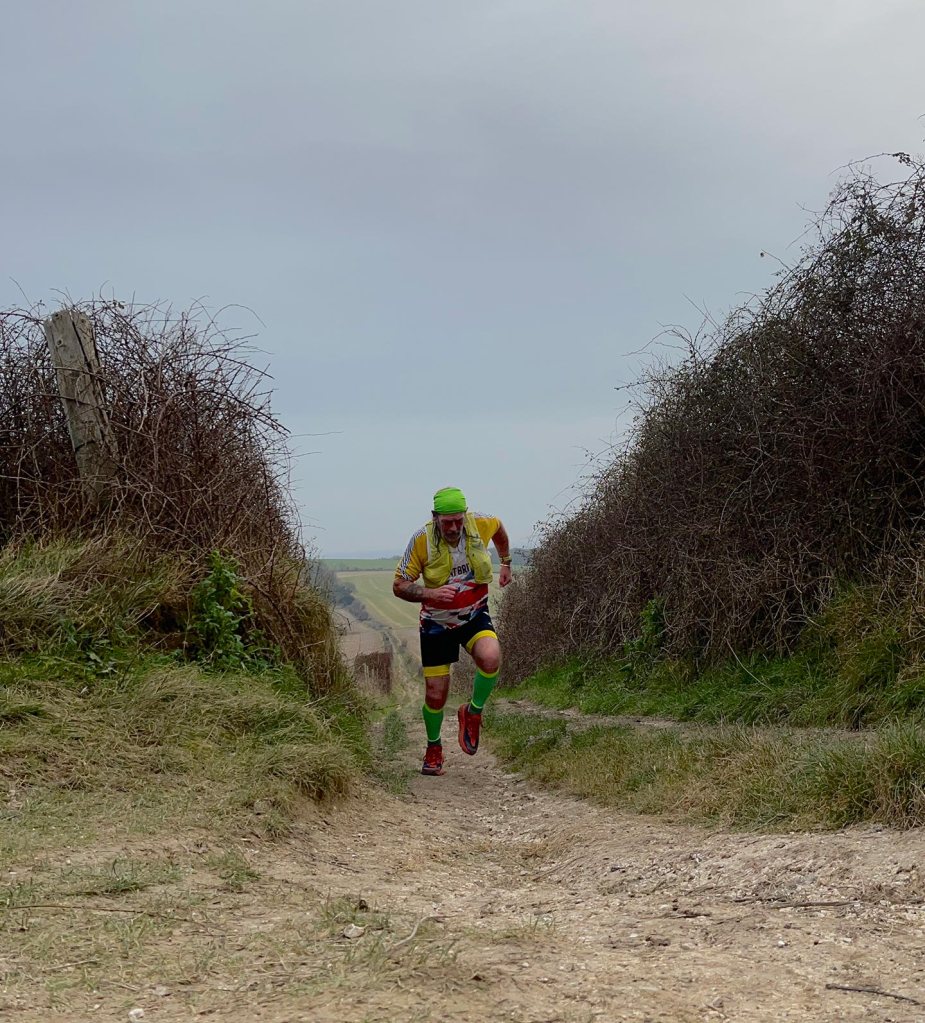
With such a short buildup I could not get near a 40 mile week, and started to see being 68, at the time, had changed things. A look at my training log showed I was naturally starting to leave bigger gaps between long runs, so nature was making me recover, even if my worries about losing fitness continued, based on my younger self’s achievements. I had to be a bit radical, and take a gamble based on years of running wisdom, and a hunch.
I trimmed a planned trail 16 miler from my plans, and slotted in an 18 mile road run to see if I could set an manageable pace somewhere near 11:00 – 11:15 a mile. I ran on a flat 1⅓ mile lap near my home, my Passepartout cycling next to me. I averaged 10:59 pace, but my legs were still heavy. Two days later I did another tough core session, focussing on strengthening my quads. I was still very tired. A 14 and 18 miler in March was due to be complimented by a 22 miler, two weeks before the 50k. The only problem was, my legs were shot! I needed an extra week of rest, keeping my streak going with one mile minimum runs.
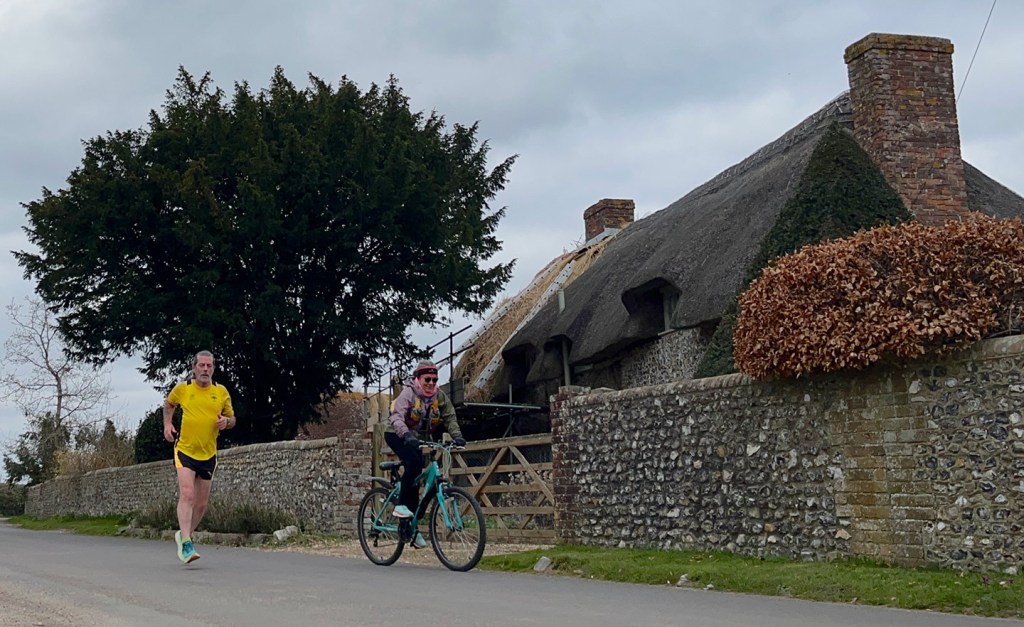
I stared at my schedule and sloughed off the last vestiges of my younger self’s ego, then made a new error, born of a gamble. I thought deep and hard. The 50k was less than 2 weeks away. What if I slotted the 22 miler into the weekend before the ultra? Would my body recover in time? Hmmm… also, the 50k was not supposed to be a race, but rather a training run. What if I ran a tough 22, then did very little for the intervening seven full days? In my mind it was possible I could experience a rebound effect and reach the start line in better condition. Does that make any sense? The only advantage I have over logic, is knowing my body. I took the gamble. I ran a very hard 22 mile trail and hill run the weekend before the race. Once done, it was too late to backtrack. I got home very weary. Could I recover?
Springtide 50k… Did I just get my arse kicked?
Another invisible factor had also gone unnoticed. My Heart Hate Variability (HRV). It is one of those readings on the dreaded Garmin App, that I find consistent with how I feel. It is the variation in the time interval between heartbeats. Hindsight is wonderful, but it showed that I’d started the 22-miler fatigued, and since, instead of recovering, my HRV had dropped steeply, from normal to ‘low’. In fact, it was at its lowest ever when I woke up to go to Arundel. My legs were not right… not recovered, is a better way of describing them.
The drive from our house to Arundel is pretty. I know the back roads, so took us through leafy lanes as the cold morning advanced. My goodness it was chilly. Yet, up above, the blue sky was unbroken – later it would be hot. By 07:30 I was ready to start. Lightweight Hoka T-shirt, club vest, yellow Gore shorts. Hoka ATR7 shoes, Injinji socks, and calf sleeves. I also wore a white, lightweight Inov8 cap – in hot weather, I find this invaluable.
As the countdown to the start hit two minutes, I took stock. There were 31½ miles in front of me. My legs were weary. Yet, I felt calm and inside the flutter of impending release. I needed this run to break through my wall of doubts. Was I ready for this? No, not as a race. But this was always a test to see where I was, to hone my nutrition plan, practise pace and running-as-I-feel. Right then, as the final twenty seconds started, I knew I’d finish.
“PAAARP!” I set off at the back of the field. In the first mile I had to weave my way between runners, along the flat Mill Road, then onto the trails at Swanbourne Lake. 11:18 for the first mile was easy enough, but immediately the hard climbs started. My left Achilles decided to ache, and the sun burned off the mist. Ahead, the train of runners had already started to walk the steep climb, so I joined in, as the going was tough and a 15:18 mile reflected this. The drop down into the Amberley Gap (the low valley through which the Arun River flows) was a welcome relief, and I found myself with a small pack of runners nipping down at 10:00 pace.
At this point the big climbs started, and my legs were already tired. From the Amberley Gap, up to the first aid station, walking more frequent than running, though I was covering the ground well enough. Water melon, banana and topping up my flasks – then down for a couple miles at 11:30 pace on the rough trails. The sun was blazing from a clear sky, and the east winds were of no help as I was in a sheltered valley. All along the route I talked to many fellow runners, every one was lovely, and each said the same – we had to respect this route and the weather. Quite. I wrote in my Running Log, ‘I already knew this race was going to kick my arse.’
10 miles went by in around 2:05:00, but the huge climb through Eartham Wood, up onto the top of Bignor Hill brought me fully into reality – I had not tapered or rested enough, I had not been training long enough and it was going to be a hard day. The next 10 miles were brutal for me. The second aid station saw me stop just to top up my flasks and swallow more water melon and banana, and I managed an ultra-shuffle along the rolling hills before I ran back down into the Amberley Gap at a good rate. Here I knew the third aid station was the last for the 8 hardest miles, so I made sure I hydrated and filled my flasks to the very top. Over the bridges spanning the railway and Arun River, my pace was still a respectable 12:20 average. Until, that is, we had to negotiate the monster 2-mile climb from Amberley up onto the top of Rackham Hill on the South Downs Way.
The climb was relentless and no one I could see even attempted to run. I’d clicked into survival mode, but was not distressed. My hamstrings sang as I breasted the hill. I’d just about found my place in the field, between 97th and 103rd and there I stayed. I was in good company of a Scottish chap and a tutu wearing runner called Gareth. Beyond 20 miles I was pretty much running alone. Any hill found me race-walking. Along the tops and downhills I ran as I could. The sun was relentless for April, but the cooling wind, now in my face, stopped any major issues. I don’t mind the heat.
During this final third I’d found peace. All the anxiety had gone and I’d stopped worrying about my tired thighs. I’d gambled with recovery and lost, but I was gaining a hell of a training run and learning on the hoof. The sun was bright and hot, but the headwind kept me cool and my hat kept my head from baking. I ran alone for a couple miles as my younger companions forged ahead, their ultra-shuffle being quicker than mine. I had to rely on my own wits to watch for direction arrows, but trotted in to the final aid station at Tolmare Farm without incident. I’d caught a few runners here, but they left as I replenished my flasks and ate more melon and banana.
From here, beyond 24 miles, the course turned west towards home. The breeze died and I was dropping from the heights of the South Downs Way. Yet, the ‘mostly downhill’ turned out to be undulating. I was alone again. Those ahead would stay ahead, and I could see no one behind. There was quite a sting in the tail. At Michelgrove was a very steep climb up into Angmering Park. My tired thighs were numb by the top, so I resigned myself to finishing well outside 7½ hours. There was no point in pushing harder. The 100k was more important. Through the trees – 29 miles, 30 miles, then down to the level ground of the Arun River valley. Over the railway and I turned to shuffle along the riverbank. At 31 miles I looked back – a young couple were jogging, trying to catch me! They must have made up half a mile on me since the aid station! I turned and fled! Well, broke into a slow run at about 11:00 mile pace. I learnt later they stopped and walked once they saw me start running faster. They were more tired than me, but I had, at least, dragged them along to a faster time. I’m an easy target in my yellow kit!
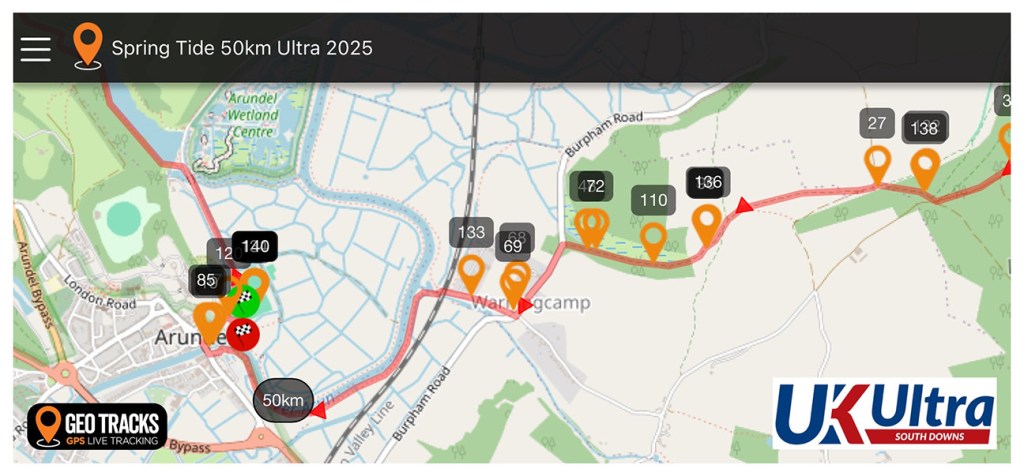
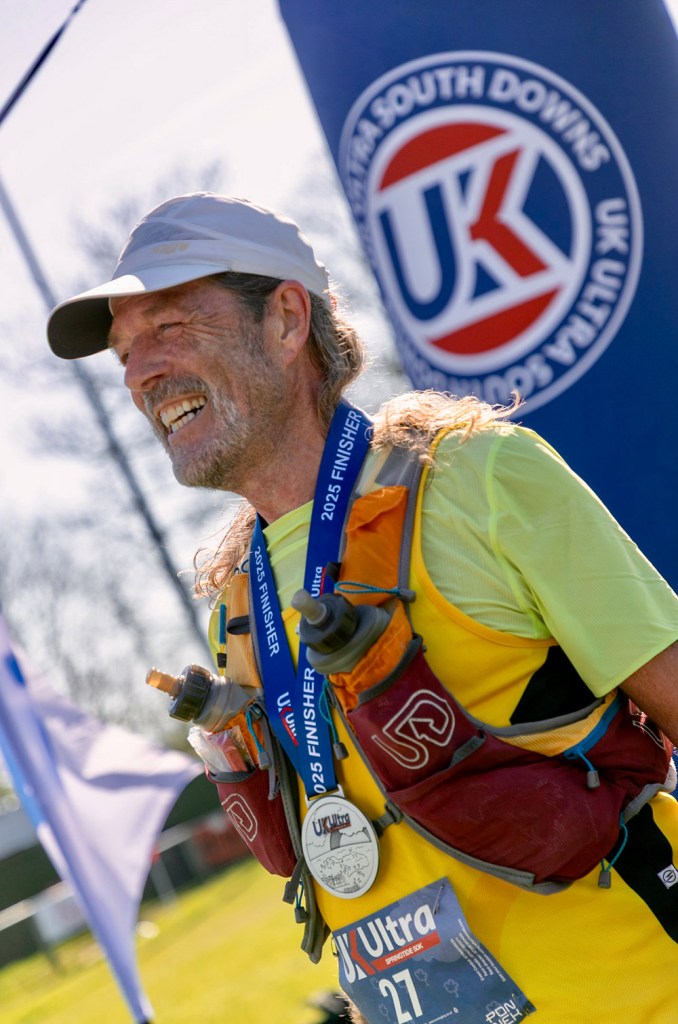
Through the houses, out onto the Arundel road bridge and I ran to the finish like a scalded cat. Announced and finished. 7:40:56. Bloody hell! I felt great! Not overly tired, well hydrated, and only slowed by my lack of recovery from March’s training load. A huge grin and a hug for my Passepartout.
I had got my arse kicked, but had also gained a great deal of knowledge. Now I was ready to recover and complete the last phase of 100k training… but life can change in the blink of an eye. And it did. 2025 became as tough a year as 2024.
My next post will explain all.
Racing the Reaper Man to Ultra: Beyond Darkness into 2026
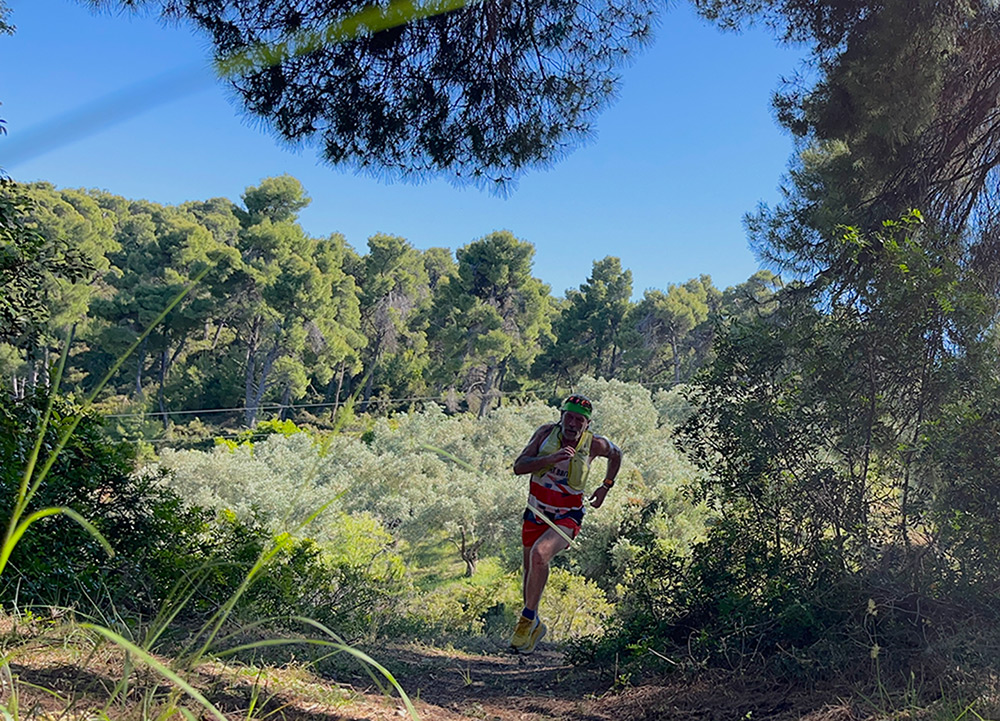
May 2025
The spring Greek heat is intense as I stagger up the hairpins, through the Aleppo Pine forest. The smell of resin is concentrated under the hot sky. Crickets chirrup and grasshoppers fiddle in the bosky groves. A single cicada tunes up with a “zizzzzeeeeee” from its invisible perch. I’m at a high point in Raches after climbing from Patitiri for two long miles. My thighs are not feeling bad, my breathing recovers quickly. I’ve finally adjusted to the heavy mileage and, suddenly, the coming 100k feels less daunting. Alónnisos is the perfect place to tune my training. At the top of the hairpins I pause. A Sardinian Warbler scolds me from the bushes. The heat beats in my ears, and I feel whole once more. The smile that comes is from somewhere deep. It comes from my inner springtime.
From Raches I can relax a bit and run freely, turning into the pine forest along a track, undulating but easier. Then, down a narrow footpath, through an olive grove, into the deep woods. The path is rocky and root-entangled, so going down it at more than a shuffle, occasional jog and walk, would end up in a fall. My footfalls are muted by a layer of old pine needles. Before long I pop out at Agii Anárgiri where I can stop the watch and enjoy my visit. Here, two little churches peer over high cliffs which tower above the blue Aegean. There is no one else here. That cautious, downhill mile has brought me to one of the prettiest places on the island. Erhard’s Wall Lizards seem to be everywhere – the males greener, and both sexes larger than those elsewhere. It is a place of peace.
Looking across to Skopelos, the view shimmers. It is very hot. Yet, at long last, I’m confident in my strength. I miss speed. Not the sub-6 minute mile pace of my younger days, but the sub-10 cruising speed of the more recent, older me. Those previous versions of me are still inside, but the machinery has aged; tuning and maintenance is a fine art when applied to a vintage machine. For now, I have the strength and endurance I need. Speed will come later.
I set off back along the rocky path – stumble, trip, shuffle. Then out onto an undulating dirt track where I can relax into a faster pace. The red dust flies around my ankles as I start to feel better – my confidence is back. 11:22. A big climb up the Tsoukalia road to the top, then down towards Patitiri. The heat is draining, but I run quicker on the metalled road. 10:40 for the fifth mile, then down the hairpin into town, past the end of the Donkey Track, through the buildings (hardly any traffic), past Archepelagos, my favourite taverna, and along the harbour’s edge. The final mile takes 10:19. My average pace is a healthy 11:27 – not bad for such a hilly, hot and dusty run.
Later, I saw my Garmin Connect App was showing something new. My Training Status had turned magenta – I was peaking! It confirmed what I already felt. The doubts I had in April were silenced. All I needed to do was manage the next month and I’d have a good chance of finally running my first 100k, the Race to the King, in June. I’d gambled with a relatively short buildup and, though not quick, I’d established a solid base of endurance. I would not be hung up on speed. I knew I could complete 100k…
… Yet, new travails arrived whilst under the blue Aegean sky, and before the end of May, I’d withdrawn my race entry.
Running into Darkness
As I write, it is February 2026. I’m well on the way to 1900 days of a running streak. Yes, I’m still running every day. I have done for more than 5 years. Even if I only manage a mile, it means I’ve been out there, no matter what. Running is my barometer. It shows me how I truly am. If I’m very down, my run will always make me feel better. That, in itself, shows I still have plenty in reserve, even if I sometimes feel I cannot endure what life throws at me. Without running, I may have fallen so far, that I might never have recovered. That daily act of putting one foot in front of the other, for at least a mile, is primal. From this I can regain my strength and face anything.
I lost one of my twin sons in 2024. I’ve written about that extensively in previous blogs. I realise we all grieve differently. Adding to this, there are other variances that come to bear. Losing a parent is awful. Yet, there is a natural continuity in the timeline of such painful events. Losing a child is so different. Even after two years, I cannot process losing my son, Glenn. It is so personal that nobody else can relieve the pain. I’ve learned that common clichés are untrue. Time does not heal. It cannot. Rather, one becomes strong enough to carry such sorrow. If not, you can fall a final time. I have discovered that sometimes grief arrives and is my companion for the day. I can do nothing to change that, so I let it walk with me, until it decides to go. I accept this as normal. It doesn’t define me, but it is part of who I am. I hope I’m kinder, wiser, yet firmer in my resolve to live a full life. I thought I’d endured enough, but life became unforgiving again in 2025.
In late May we lost the most venerable, senior member of the family. A kind, wise loving patriarch we all loved absolutely. Immediately our lives changed and any plans erased from the calendar. The 100k was gone. It had become unimportant. Then, to my great shock, in June my first wife, Lynne, died after a long illness. My surviving son, Iain, had lost his twin brother and mother in just 15 months. Life seemed so grotesquely unfair. All I could do was continue my supporting role. I had to. I’m the old silverback of the family, now. At such times of bereavement, families rally and close ranks, help the ones who need it and share the burden of grief.
How does one get through? Cry, feel sad and lost. Howl at the moon, if you must. It’s all ways of coping and relieving the pressure. I did all of it. One thing I stepped back from was self-pity. Once self-pity gets hold, the drive to keep living flickers. Self-pity is a cliff edge below which is only darkness. You make yourself the only victim amongst others who hurt just as much. It becomes self-isolating, and worst of all, self-perpetuating. The only way to endure is to keep moving forward. If you cannot help yourself, find strength in helping others. Talk to friends. Stay busy, even if you have no motivation to do so. In the end you will get momentum back. That forward movement keeps you ahead of my metaphorical Reaper Man.
I am a runner. It is my escape from the madness. I am also a writer. In the last seven months I’ve found it hard to focus on prose and content. Yet, Racing the Reaper Man has always been my way of encouraging forward momentum. I am not an elite athlete. I’m nothing but a normal chap. I’m also getting older at an astonishing rate of knots. So, once the initial impacts of the last couple years had eased, I felt able to complete the blog posts I’d drafted out in 2025 and left in limbo. This one is an amalgam of those unused sketches. Thus, by keeping busy in what one enjoys, one can proceed onwards. With momentum, one moves from darkness into a new day.
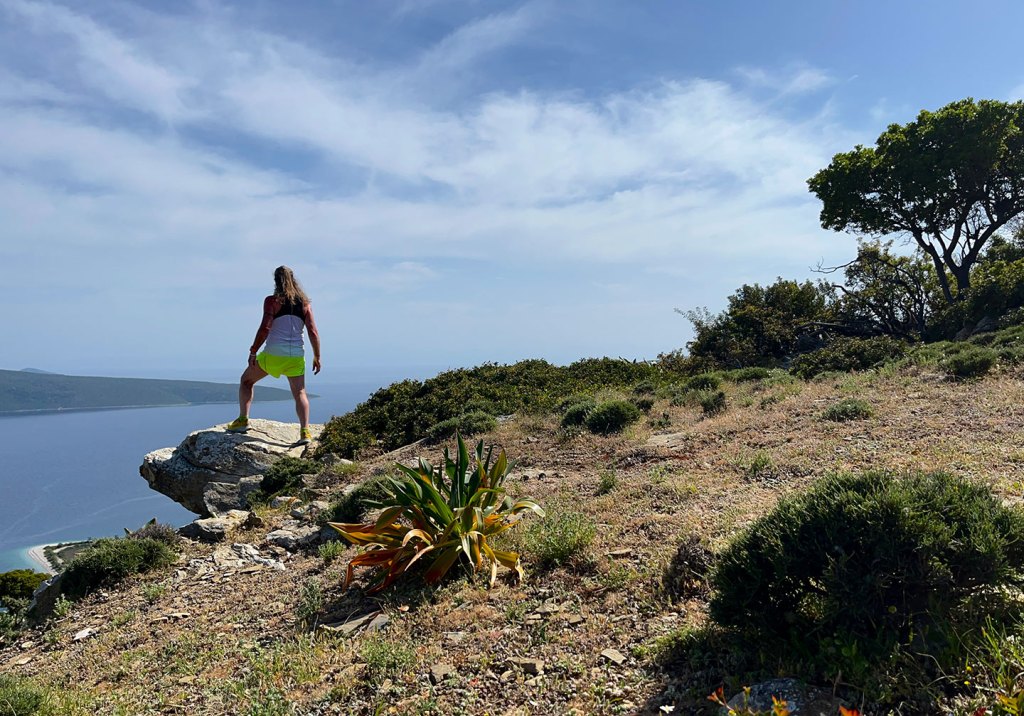
Embracing my 70th Year
I was born on 1956. Bloody hell. That means, by the end of September, I’ll be 70-years old. I have to blink at that as I write. As I can blink at that, it also means I’m still alive. Reaching the start of 2026 has been a symbolic rebirth for me. For some, New Year’s Day can be shrugged off. Dry January can be scorned as a gimmick. However, I find I need that ephemeral frontier between the years to step into a place where, psychologically and physiologically, it feels like a new start. And, with so much pain punctuating my life from 2021, my 70th year, proper, looks like a chance to move in clear air.
Upon reflection, I had started 2025 in good shape after shaking off a long-term, chronic injury. I hauled myself into 100k shape, but had to let that elusive distance go for another year. Through all the months of support, love and repair, of learning to carry grief without falling, I kept running a minimum of a mile a day. My intention was to increase my training mileage in December, through early spring, and to run the Springtide 50k again in late March 2026. After that, peaking for a summer 50k and make my long awaited 100k debut after my birthday. A sound, longterm goal. All looked well. Then, 2025 decided it wasn’t finished with me.
In October, kneeling whilst fannying around in the lounge, twisting and generally doing nothing too active, I buggered my left knee. I gave it no thought. As I stood up I got a twinge. It was a gentle be-buggering. A day later it hurt more. I kept running, but it was sore, especially when standing from a sitting position. Straight to Ricky, my physio. Yes, I’d inflamed my knee. After a bit of treatment, I left with some exercises and a ‘not too many miles’ instruction. It got a bit better.
Then, in December, after a trail 6½ miler, it got uncomfortable and twangy again, and decided to swell a bit. Back to Ricky in the first week of January. Now, Ricky is very good, I trust him implicitly, and he is also very kind. Instead of calling me a twat, he used his 3D models to show me what the problem was. I left with more exercises and the knowledge that I had to do something sensible, for once.
This latest setback became a monster in my head. In consequence, that elusive 100k is in danger of becoming a mental block. A nemesis. An impossible barrier. There is no doubt that I’ve started to overthink the bloody thing. I needed to get back to basics. Thus, I’ve had a stern word with myself, and readjusted my plans for the lead up to my 70th birthday. I’ve abandoned the spring 50k and decided I must get this knee properly healed. So, I’ll run a road mile a day in my well cushioned Hokas, and religiously do my knee exercises. I did start an icing and compression regime, but found it was exacerbating the injury. So, I reduced the level of compression and used a heat pack. The upshot – by early February the knee was very close to being fully recovered. And that’s where I am. I will not start any build up until my knee is fully restored, and stronger. That may be as late as March. I can do lots of core work instead. I’ve started looking for a July or August 50k.
I keep copious running records. My Running Logs stretch back to 1982, to the very day I started. In the most recent few, I’ve kept a count of calories, booze units etc., too. I’m honest with myself. I noticed I’d grabbed for the single malts far too regularly over the last two years. It shows an almost unconscious step to using booze to cope. And that’s what I’ve done. That one habit is not a good one to leave unaddressed, as it can engender reliance, then worse, allow self-pity a route in. You see, my son died of alcoholism. The shock of seeing where I was going felt like a betrayal of any lesson I should have learnt. I realised I needed to embrace Dry January. I’m starting to consider a longer period of abstemiousness. Now, here I am in February, with the pressure of heavy training removed, and totally sober every day. The net result is I’ve regained my energy. The sluggish start to the day has gradually evaporated. And I’m sleeping again. The nightmares have gone. I am determined my knee will be stronger once it’s fully repaired.
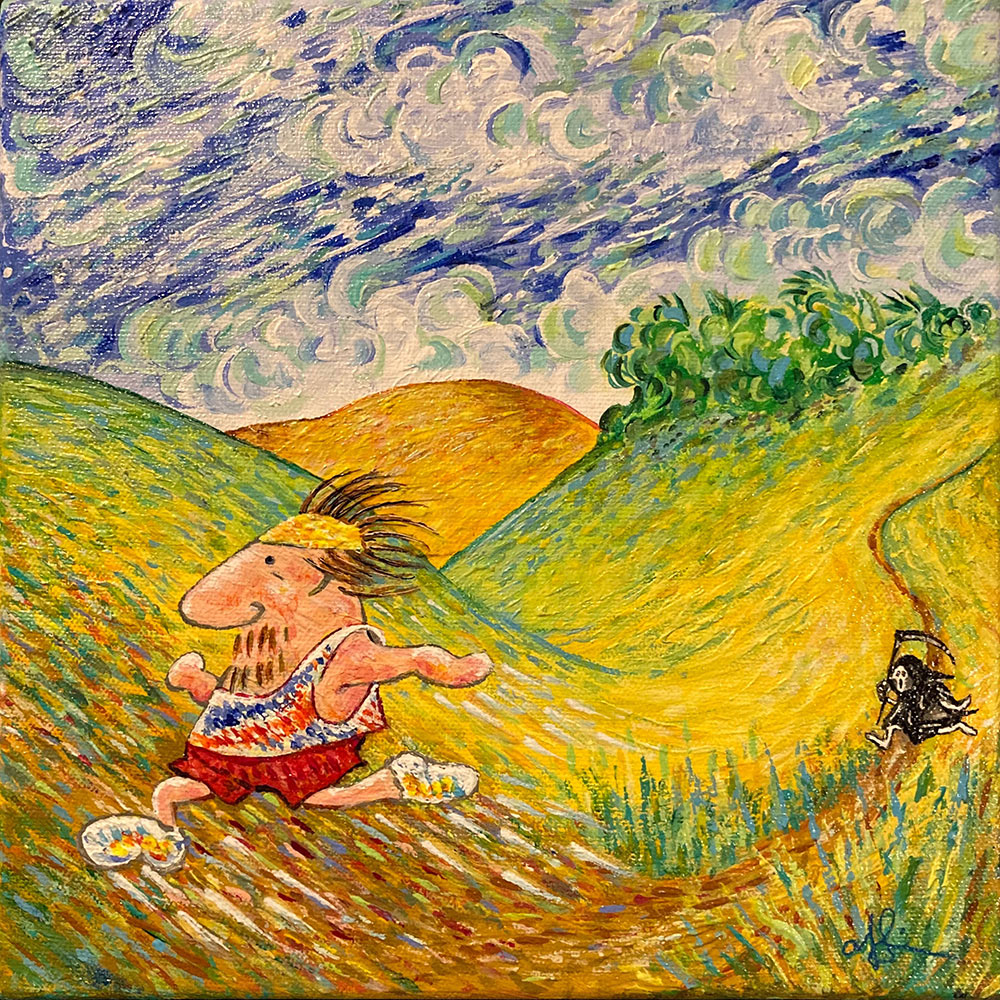
Acrylic paint on canvas
© Angela Jane Swinn
Laughter is Sunlight
As I keep up my run through life, I seldom mope about the past. I look at it through a type of rearview mirror. I’m fairly lucky as I quickly forget unhappy times. I can do that as I make sure I learn from them. I carry the lesson, not the pain. I also find humour in most everything. It’s the way my mind developed. I’m glad it did. Starting afresh without humour would be like befouling one’s underpants, then changing one’s shirt.
Laughter is the best drug. Comedy is a parody of life. Comedy is a mirror for us to see how ridiculous we can be. It is not literal. I’m of the mind that it should not be censored. There is no hate in any true comedy, just a big mirror. An example is the fart. It is always funny. Even if I’ve had disasters whilst running, with the fart, the tale is hilarious forever after. There is a borderland where unfunny people are cruel and resort to mockery to enhance their bigotry and standing with fellow arseholes. That is not comedy. Laughing to such nastiness shows fascist tendencies. Anything else is down to choice. Never cancel, just ignore.
It is February 2026. I have caught up with myself. That is where I’ll leave this blog. I’ve moved beyond darkness into the sunlight of a promising 2026. Sleep and no booze has transformed me. My mojo is back. I’m getting things done. My daily mile is quicker than before. My knee is getting better by the day. My 70th birthday has hove into view and it no longer worries me. As a V70 I can write a new chapter in my running life. Let’s see how 2026 goes.
Racing the Reaper Man to Ultra: 2000 Days – Sisyphus or Heracles?
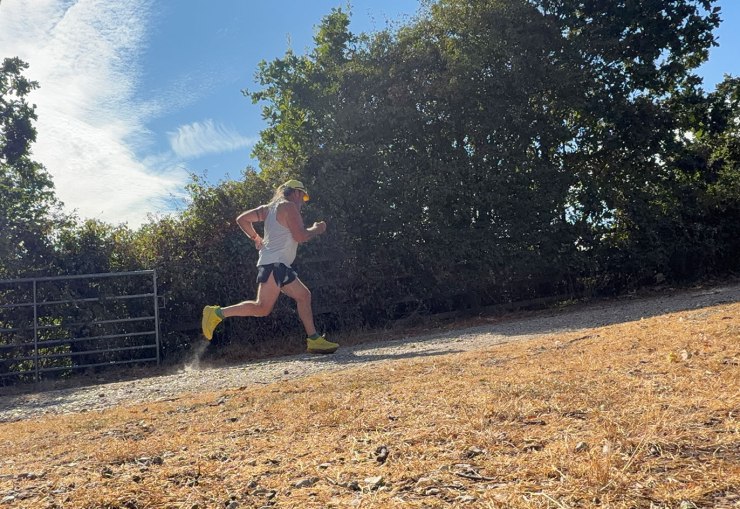
Why does anyone want to complete a 2000 day running streak? To be honest, I’m not really sure I can answer the question in simple terms. My ongoing streak spans the best part of 5½ years. It is more than a simple routine, separate from everything else in my life. I’ve had to live it, live with it, accept it as normal and absorb it into who I am. After all that, I’m still struggling to answer logically. I’m not sure if I’ve been emulating the pointless rock rolling of Sisyphus or the imposed labours of Heracles. If Sisyphus, am I doomed to continue? If Heracles, am I at an ending of sorts, and free?
There is much debate about whether adhering to such a streak is sensible. Fair enough, but the word ‘sensible’ tends to be relative when it comes to running beyond 5k. In marathon running it loses any semblance of normality. Once one reaches ultra marathon running, it becomes irrelevant as an adjective. Thus, I will deconstruct those 2000 days, explain the personal rules I adhere to, the key events and whether it has had a positive or negative impact on me. That way, I can come to terms with it myself.
My streak rules
There are generally accepted rules for a running streak, and I interpreted each with a little flexibility which I will set out below. These are my rules.
- Run a minimum of a mile a day. A day is from midnight to midnight, and the mile must be fully bracketed by these times. I have divided a mile run into two parts, on occasion. For instance, running to a shop, and back, to cover a mile, just pausing to pick up a few items, then returning home. However, this has never been two independent journeys with different objectives, and never less than half-a-mile at a time.
- Cover the ground at ‘effort’. This is important, as I always knew there would be times I would be unwell or struck by an injury. The ‘effort’ has to be balanced with health level. If fit and healthy, that may be a 10:00 mile or much quicker. Call that 80% standard effort. If unwell, or injured, that 80% effort remains the same, but the speed will drop. Thus a much slower mile will count if the energy expended is at 80%. At my slowest I utilise the ultra-shuffle – one foot in front of the other from A to B. An extreme example would be if one was on crutches and hopped a mile in 30 minutes. Would it count? Effort says yes. Purists would debate it. (Set your own rule.)
- Record every run. My streak is recorded in my training log. Every run. Every mile I’ve covered.
Why did I start?
I started by accident on 27th December 2020. I was aiming to get to 1000 miles for that year. After missing a whole week earlier in the month due to work commitments, I was stuck on 958 miles – so close, but so far. On 26th December 2020 I had a rest day, and had decided not to bother trying to fit 42 miles into 6 days, as I was knackered. It bugged me. In the end I found the challenge was too great to resist. I ran a 6, 10, 10, 10 and 6 to get to exactly 1000. Then, I just kept going. In 2021, I started to work with my Personal Trainer, Martin Sorenson, as the subject for his MSc, and by July realised I’d not missed a day. Way back in 1984 I ran the whole year without a rest day, so thought I’d replicate it.
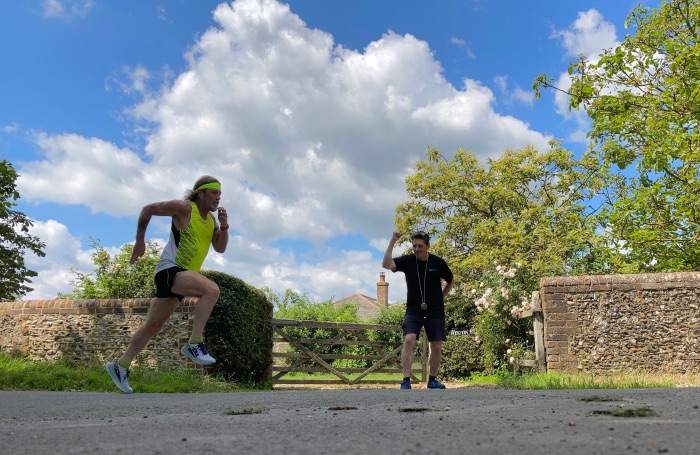
Why did I decide to keep it going?
After the anniversary year, then a full calendar year, I’d noticed a Facebook friend in Jersey, Dave Woodsford, was on the way to his target of 1000 days. By now I’d committed myself to ultramarathon running, and thought such a target would mesh with that odd discipline. So, by 2022 I committed myself to 1000 days. Thanks Dave, you were my inspiration. Upon reaching 1000 days, well, why not 2000? I could never find a reason not to run.
Psychologically, it gave me a constant positive. No matter what happened in my life, I could always have some Me time, even if that was just 10 minutes. At moments when giving up would have been easy, it made me get up, get out and be alive. Eventually, not going for a run became unthinkable. It still is. You see, the streak became self-perpetuating. Now, running each day is a natural way of life for me. And that’s the key. One has to believe running each and every day is nothing special. It’s normal. That way, you’ve not got to justify your reasons. As I write I’m less than three months from my 70th birthday. I honestly believe that my choice has given me the best chance of living a longer, healthier, more fulfilling life.
How hard can things get?
This is a simple question, but the answer is multifaceted. Going for a run is easy enough. To do so every day, for just short of 5½ years, encompasses a lot of life. One does many things over such a time span, and a lot of unplanned events occur, so going for a run often becomes something to fit in where it causes the least disruption. From the outside, life-changing events make a run seem unimportant and almost irresponsible. Context and thought come to bear. Decisions have to be carefully considered. At times, going for a run to keep a streak going can upset those closest to you, with good reason. Thus, diplomacy and understanding should take precedent over stubborn adherence. Quite simply, make sure you are running for the right reasons. Below I’ll cover each valid reason to not run, with an overview of why I did and do.
Travel
Any journey takes planning. Whether a weekend away, or a holiday in the UK or to foreign parts, continuing a streak can be difficult. It’s easy enough to run when you get to your destination, but the journey to get there may take a few days.
If travelling by car, I run before we leave. If the drive is over a couple of days, I may run once we reach our overnight accommodation, then, perhaps, early the next morning before breakfast. Sometimes, I have run part way through a drive. I’ve stopped and run in Glen Etive, through Grantown-on-Spey on a dark evening with heavy frost and across the rainswept Flows of Sutherland.
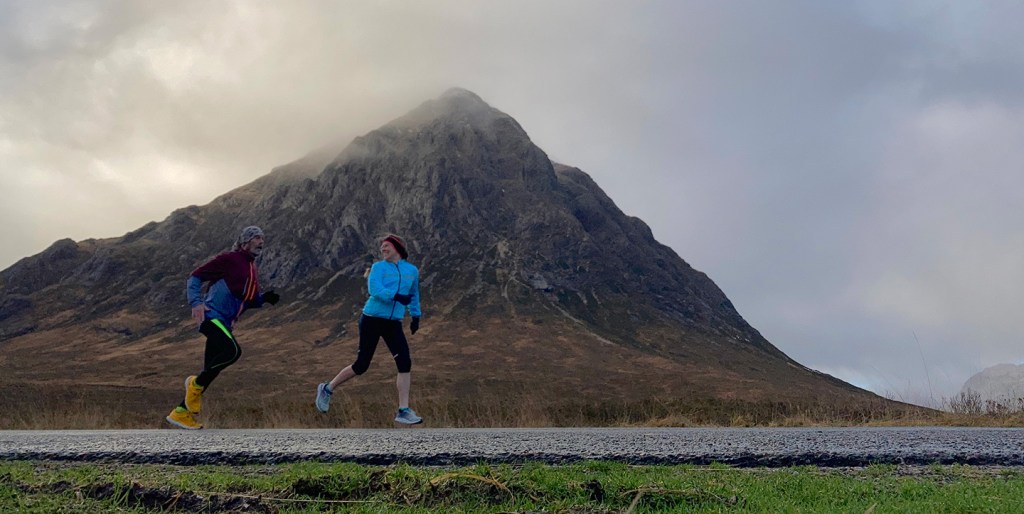
If flying it depends on flight times. I can run early, before the drive to the airport, or after landing, upon arrival in my destination. I’ve even run mid travel, along the quayside of Skiathos whilst waiting for a ferry. I have yet to do a long haul flight during my streak – that would be interesting…
The biggest problem is overcoming the natural “Why bother?” feeling. Especially after a hard day. This is commitment to the streak, with no impact on others.
Illness
This is a big issue. One that needs careful thought. My logic revolves around a run being a natural part of living each day. Even when unwell, or injured, you still have to dress, go to the loo, shower, eat, walk etc. To me, a run is just one more thing. A lot of people think running is bad, or unnatural in a funny stretch of logic. So, there is the tendency to brand an unwell person going for an easy jog as stupid, reckless or thoughtless. I think that I have a natural, built-in safetyometer. I don’t think I’d exercise if my heart, lungs or brain could be harmed. So far, I’ve got it right, but there have been a few occasions where I’ve had second thoughts.
The worst-case scenario I had to endure was in a hotel with my wife during a family emergency. Before the journey there, I developed severe prostatitis – a nasty bacterial infection of the prostate. I had been prescribed the wrong antibiotics, and suffered dreadfully until the correct medication was identified, and sourced near the hotel in a local pharmacy. On the worst day, my wife was beside herself, as I’d spent the night trying to urinate many many times. A couple of times I was crawling on the floor in discomfort. It was a case of drinking lots of water, and trying to flush my system through a reduced, swollen exit. The following day I announced I was running a mile. My wonderful Passepartout almost locked me in, but gave in if I followed her. So, I got changed and could barely keep up as she walked and I shuffled behind her to cover a mile in 21 minutes. Trust me, a 4 minute mile is easier. It was 100% effort. Before you judge, at the end I felt better in myself as my body relaxed and I felt human. From then the correct antibiotics started to work and my runs were less stressful.
With other illnesses, the safetyometer has to be fully operational. In 2016, when I was suffering burnout in my job, I contracted 9 viruses in a row. I was constantly ill. I was not on a running streak, then. The pressure of unfair workload and negative management can really hit one’s health very hard. The upshot of that is now, even though I’m through that part of my life, any virus tends to knock the legs out from under me. I always lose my sense of smell, and always feel dreadful. Yet, I still run. But, I run very, very easily. And never more than that set mile. If ever my heart and lungs are affected, or if I’m bed-bound, I would not run. I have yet to get to that point.
I have, in the last 5½ years, had a few minor surgeries. Each time, I have run early, had the procedure, then jogged late the following day. This way I managed to stay on the sensible side of keeping pressure off stitches.
Injury
In 2021, the first full calendar year of the streak, I had a fabulous time. At 65 years of age, I ran a 25:43 5k, winning my age group, ran a 4:30 marathon, and a 5:18 50k, in the middle of heavy training. The Covid pandemic ruined any hopes of a summer ultra, but various lockdowns gave me focus on core work and long, people-free trail runs. By the autumn of the year, I’d noticed my right leg would occasionally give way. And my right Achilles was tight. After a few months lighter training, I ran a very good autumn 50k in 5:54. At 16 miles, my leg gave way, and I fell, rolling acrobatically to a stand without injury, then in the last few miles my right calf cramped horribly. I lost at least 20 minutes. I saw my physio for a few visits, and spent the end of 2021 exercising my right leg. It felt better.
2022 started with me focussing on the Race to the King 100k. Whilst running a ‘training’ 4:15 marathon, my right leg started going numb again after 18 miles. It cost me 5 minutes, I’m sure. I decided to ignore it as I felt so fit.
A short time later, I set out on a hilly 32 mile training run. I had a support team – my wife and Martin my Personal Trainer and good pal. On a warm day I was running well but my right calf would cramp randomly, and the whole leg would decide not to work for a split second. I reached our 14 mile rendezvous, changed shoes for the big hills and trotted off to scale the South Downs. I struggled up the various climbs. My leg was not cooperating. Down to our second rendezvous at 19 miles I was scratching my head. I could clip along at sub-9 minute miles on descents, but my leg was not liking the climbs. I felt great, full of running and well hydrated. After more climbs, my leg started to give way on descents – very scary as I had no control. So, I plodded to the end, feeling very fit, but knowing I had an issue. I dropped out of the 100k as my leg was getting worse.
This time I took my physio’s advice seriously. The injury was worse than I’d imagined, and it led to low mileage from late 2022, to early 2025. The streak continued, but the injury kept my training low key. 2025 looked much better. Finally, I was free of pain. Cured! I completed a very hard 50k in February, 7:40 being slower than I’d hoped, but it was a monstrous route. However, my legs were alright. I’d entered the Race to the King again, and by May, was ready. Then, a death in the family meant I had to drop out again.
I’d lost heart. In the autumn I knelt awkwardly and hurt my left knee. More physio. Then as that got better, I fell during a trail run and hurt my right knee! In early 2026, I’d decided to not train much until I was properly free of injury. I’d also taken the pressure off by deciding not to run any ultras until after my 70th birthday in September. And that’s where I am.
My physio, Ricky Lidbetter, told me I could continue running, but low mileage and mainly on roads. So, the streak survived. Ricky eventually discovered the cause was an old back injury from when I was 19. Finally, after months of work, the pain was reduced, then gone. My knees were fixed.
The lesson – if you know you’re injured, it won’t go away – see a physio and do as you’re told. However, running may not necessarily have to stop. It’s a personal choice that must be made with the help of an honest expert. Ricky is one of the best.
Impossible moments
For me, 5½ years of running every day, and counting, remains a way of life. This is where context comes in. Unless one understands that, a run can seem superfluous when serious issues occur. I have found that my mindset is often at odds with the preconceived perceptions of others. I’ll give you a fictitious scenario.
You find out that your beloved grandfather has been taken to hospital with a serious illness. You have to travel, with your wife, across the country to see him, to make sure he knows you love him, and to show you care. It’s normal. You arrive at your hotel, and you both join your sister and her husband in the bar. Everyone is upset. Your brother in-law decides to get a round of drinks in, as we’ve all had a shock. You plan to see granddad the next day – he is stable. Grandma and your parents are with him. You ask for a soft drink as you want to run before dinner.
“How can you think of running, at a time like this?” Asks brother-in-law.
Your sister is weeping quietly, your wife comforting her.
“Maybe you should give it a miss, today,” suggests your wife.
It’s a tough position to be in. What would you do? This is where context comes in. I personally would not mention a run. I’d just do it later. Justifying a soft drink is unnecessary. It doesn’t matter if categorising a run as a selfish act is illogical, one has to realise it can be the focus for upset. It’s pointless saying it’s no different than a walk around the block. In such circumstances, it’s best to remember your run is just what you do. It’s not necessary to justify it. Just don’t mention it.
My son died in 2024. I did not have to justify myself to anyone. I ran to clear my head. I ran to weep and feel the effort of living. I ran because staying still hurt too much. This was my impossible moment. The streak did not exist – running did. I ran because sitting around gave grief too much weight. I regret nothing. I still run when I get sad. It is my time to let grief become energy to burn up. I run to his grave to say “hello”. I run back knowing I still love him.
You’ll never stop people judging you. It’s human nature. I’ve learned to be kinder. I am fortunate as people see me as the chap who runs. I’m accepted. I am convinced if you are kind and full of love, you use less energy and life becomes brighter. Running is my meditation. It burns my negative energy.
I hope this makes sense. Ultimately, you have to be at peace with yourself. Grief shouldn’t stop you doing the things that make you healthy and happy. I’ll leave this section with a quote from Benedick in Much Ado About Nothing: Act 3, Scene 2:
“Well, every one can master a grief but he that has it.”
No one should take away your own way of coping.
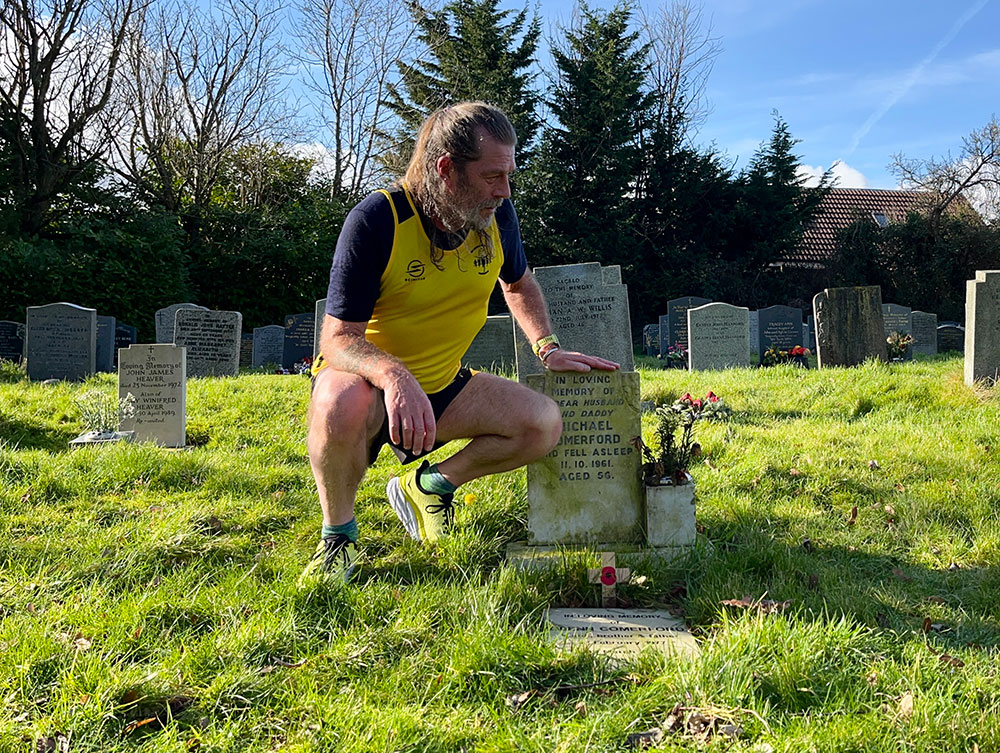
The negatives
Running every day is not easy. If it was, it wouldn’t be worth doing. Yet, to give an honest overview, I must put down the negative aspects. The bulk of these are the inconveniences of slotting in a run as covered earlier. You will clash with people in your life, but always remember to be kind. Most of the time they care about you, or the effect it has on you. This is especially so as I near my 70th birthday. I’ve got to the point of saying, “I never get home feeling worse.” That simple phrase is true. Others closest to me know that.
There are times when I’m ill that I know I will feel the symptoms of my ailment. I once had food poisoning in Greece and was travelling home. Finding a 15 minute gap to run, between explosive bouts of Montezuma’s revenge, was tricky. You will feel bloody awful, but will know when you’re getting better. Just never trust that tiny fartlette…
There are no real negatives, for me, just occasional challenges.
The positives
Whereas the negatives are centred upon inconvenience, the positives are manifold. The following are from my own experiences and reflect my own mindset.
First, you maintain a base level of fitness and mental strength. Even that one mile is better than no run. Getting out there, even when every fibre of your being is trying to make you sit in a comfy chair, avoids the feeling of giving up, and enhances the feeling of achievement. Some days that mental rejection of running is extreme. Beating it will beat giving in. You will see an excuse for what it is, justification for not doing something positive. This gives you the edge in other health drives. Giving up booze for a few months or forever, switching to a healthy diet, or reducing work stress can be hard, but necessary. If you have the built in stubbornness to run every day, that same strength of mind will get you through.
Second, you will have a barometer of how you are, physically and mentally. You will know when you’re getting unwell long before most. It prepares you. Okay, jogging a mile if unwell will magnify the symptoms, but will also show when you are recovering. I am stronger for it. I know Me much better than ever. Mentally we can become exhausted, overwrought and stressed. A run will help you think, relax and focus on the now.
Thirdly, it tells you when things in your diet are not right. You can feel yourself getting heftier. You can feel if boozing is starting to get out of hand. You can feel your age creeping up, to borrow a metaphor. You can feel the breath of the Reaper Man, to use my own. A running streak will get you to many crossroads, and what you put into your body will be one of them. I get to this point sometimes. I reflect, I debate, but the run and how I feel whilst running wins. I adjust and keep on the healthy track.
Fourth, it expands one’s mind. That is a bold claim, but that is how it is for me. It extracts me from the virtual world. Right now, everyone in the West, if not the whole WiFi linked world, seem to be plugged into a smartphone. To cut to the nub, I see there is a new, insidious collective stupidity afflicting Homo sapiens. The real world and screen-dominated, virtual world have become mixed. Populism thrives in this environment. It allows personal biases to be supported, emboldened and expressed, openly. Complete lies and fiction are accepted as they tickle that hidden bias within. Racism, xenophobia, stereotyping of the worst kind is now an undercurrent throughout our lives. Bent politicians are lauded if they say what a person’s biases need in order to surface. Whatever happened to make the voices of hatred become acceptable? Well, I’m still content to call them all buffoons. The noise can be relentless. If you unplug your head and run, you’re free. No earbuds for me, they just isolate you from the natural world. The calm I get from a run gives me time to think things through. Peace and kindness is all that is necessary. I’m not sure what that makes me. I’m an atheist because I think. My mind will not let politics and religion, with all their open corruption and madness, be swayed from critical thinking. Running has given me my free mind.
Last, in a far from comprehensive list, is living. At 40 or 50, the common ailments of getting older may have yet to make themselves known. But they will, unless you take care of yourself. As time passes, our past catches up with us – literally. Life is not short, it is the longest thing we will ever do. It is the most personal journey we will take, too. To make this a successful event, we must keep the vehicle in good order. For me, life is precious – I can’t think of anything but that cliché. Why then would I treat my body and mind with anything but respect? This is where excuses can kill us. If you’re unfit at 30, 40 or 50, get fit. Get healthy, too. If you’re over 60 and in bad shape, change it. If you don’t respect your body, what you do to it will end your journey prematurely. If you race the Reaper Man, keep ahead as long as you can. Make sure he’s knackered when he gets you. I’ve run in mountains, along rivers, across bleak moorland, along African beaches. This solo machine that is me, has seen wonderful things. Not once have I regretted it.
Lessons learned
Be honest with yourself
On the 2000th day of my streak, I’d just been through months of the most negative mental turmoil I’d ever experienced. I’d had to spend 4 years recovering from injury, illness and coping with deep grief. Every time I thought I had clear air, something took the legs from under me. In May of this year, after two nasty viruses in succession, I lost heart. I’d stopped enjoying running, I’d stopped believing I could ever get ultra-fit again.
I’d set out on each of my short runs and feel breathless, hopeless and lacking confidence. I couldn’t understand it. There was something missing. Was I overtraining by continuing the streak? Had I damaged myself by not resting? Was old age finally overcoming my body? The twist was, I knew what it was, but I was in denial. I finally put emotion aside and looked at what I was doing opposed what I wanted to achieve. The truth was hiding in plain sight.
First, the last 4 years had taken a huge toll on my mental and physical wellbeing. 4 bereavements, supporting those I love and putting right some great wrongs by my former employer had made me fragile. It seemed to never end, and the effects were unquantifiable. I’d not given this much credence until I’d reached rock bottom. Now I acknowledge this, I can see that my confidence only seemed low – I was just, plain emotionally exhausted. I needed to embrace rest and reset my goals.
Secondly, booze had become a daily habit. Not vast amounts, but far too much by my own standards. I’d not drunk anything in 2026 until late March. April to June was a different story. I was waking up bleary eyed and flat. The athlete I wanted to be, indeed have been, required abstinence.
Thirdly, I had to accept that being close to 70, any increase in fitness and performance would need to take age into account. I’d tried to ignore this natural decline, but that was the trouble. ‘Decline’ is very negative. I now look at it as natural adjustment.
Finally, I stopped being controlled by the watch. I’ll cover that in the next section.
Training and goals
2000 days of running would suggest I would be fit for anything. However, the bulk of these runs were short, and whilst I was under great pressure. The truth is, I was only fit enough to run short runs. After low key running for so long, my actual fitness was at odds with my perceived fitness. I thought I was fighting a losing battle, but was only showing that low mileage training is only good for low mileage running. I’d been fooling myself.
Crucially, I had become a slave to my watch, my lovely Garmin. It is a great tool, but now I’d let it become my master – and it was a very critical master. I found myself overcompensating for my actual fitness, and needed every run to be faster than the next. For months I was pushing into oxygen debt, without structure. I was scared of longer runs, because I saw running slowly as failure.
Memory is a funny thing. If you think to moments in the past, it is not just pictures you see, but emotions and physical feelings. I remember running a 2:49:15 marathon. I remember a 78:13 half marathon. I know how I felt. I know how easy it was when I was fit and young. As I write now, I’m just 2 months from my 70th birthday. Of course I’m a different athlete, it’s hardly a revelation, but it was to me.
In June I watched the Race to the King 100k runners pass through Farm Lane, just 50m from my house. It was uplifting. Then I heard a “Hey, Paul!” It was a friend, Lottie, whose mum, Sarah, was running the race too. Sarah was way ahead, but Lottie was taking time to walk/run and compensate for lower level training. We walked to the road crossing point together. She was bright, happy and full of motivation. Later, I realised I felt great! Lottie was running her own race and living in the moment. It was time for me to do the same. The next day I entered the 2027 Race to the King 100k.
You see, procrastination and prevarication are not honest vices. I’d become scared of full commitment to becoming a V70 runner. I’d allowed bad habits to creep in, and ignored them, putting my lack of fitness down to my body giving up. That day in June threw a switch in my brain.
Initially I was thinking, what’s the point of running 100k if I’m slow? It’s embarrassing and would show me to be past it. What a twat! Thus, I asked a different question. If I ditch preconceived pace based on past exploits, would I feel better? If I worked towards getting into proper shape, running to how I feel, would becoming 70 become a great motivator in itself?
My goals were adjusted and to reach them I adjusted my diet and mindset. I worked out a training schedule for a 50k in November. Gentle and gradual, at first, working on base fitness until the end of July. My goal is to get through it in under 7 hours. Modest for a 65-year-old me, but challenging for a 70-year-old me. I would let the 100k look after itself. My goals are now one step at a time. Each will bring me closer to understanding what my older body can do. I can set time targets based upon what I learn.
Make peace with yourself
I have no experience of being 70. All I know is I’m fortunate to be in good overall shape. The maladies linked with being in my 60s have been endured and overcome, thus far. I’ve yet to go grey, and, prostate aside, have yet to be struck down with any of the common ailments linked with ageing. Much of this is genetic, for which I thank my ancestors. The rest of it is down to respecting my own body.
Going to war with your body is something I stopped doing a long time ago. I’ve made peace with myself. It is a real choice to be healthy and fit. It’s even more so as you get older – the war you’ve put your body through will show the chronic effects through your 40s, 50s, and 60s. I remain baffled by the cultural acceptance of physical self-harm. That is why I started the Racing the Reaper Man blogs. To encourage people to take responsibility for their own health, fitness and mental attitude. It is no burden. It’s emancipation from myth, mores and madness.
Another of my sayings is that life is the only countdown that goes up. There is no predefined zero. There are no guarantees. There are, however, plenty of ways to load the deck in your favour. If you love life, if you love yourself, make peace with the vehicle that transports your mind. It is a very personal choice. Make no excuse, if your body is abused by what you do to it, you are at war with yourself. It smacks of giving up. I’ve also said, I gave up once and nobody noticed. There is great truth in that.
The streak has given me a base from which to rebuild. It’s not luck. It takes thought, commitment and making peace with our wondrous bodies. Once the Reaper Man puts his metaphorical hand on my shoulder, he will be out of breath and it will be on my terms.
Reset – start afresh
After those worst 4 years of my life, I’ve finally come through the dark days into clear air. In June I started to treat myself as an athlete again. No booze, daily core exercises and my streak continues. I’ve allowed myself to start afresh and adjust my goals to suit my ability. Ultra-running is what I want to define my 70s. It’s as simple as that. It’s not all-consuming, but a part of my widely varied life.
This fresh start has been a revelation. My easy running is now between 11 and 12 minute miling. That’s my ultra pace on level ground. It’s comfortable and thoroughly enjoyable. In real terms it may sound slow to young racing snakes or older elite runners, but that equates to a 6:13 50k. A very respectable time for a V70.
I’ve started working towards my post 70th birthday training goals by trimming my body down, increasing strength work and forgetting what I managed as a young chap. I’m adding speed and hill reps. My guess is my endurance will benefit first, speed may come later.
The running streak has adjusted my philosophy by experience, not by rote.
Would I advise it?
Yes. Not necessarily for an open-ended period, but as part of a training plan. Rest days are important, but a mile jog on such days can loosen you up, and teach your mind to overcome excuses. If you train towards a rest day as a reward, it can be counter intuitive. With a streak there is no rest day. Thus, one’s focus is on the key training of a schedule. Sisyphus or Heracles? I’d go for Heracles. He worked to get things finished, then carried on. (Note: Heracles was influenced by the gods to do some pretty horrid stuff. Thus my comparison is a flight of selective fancy, not one of moral attribution.)
A streak is very personal. Start one for the right reasons. Injury and illness have to be taken seriously. My own examples are personal to me. What seems to be pigheadedness to you, is not giving up, to me. It’s always going to be a point of debate. For me, it’s got me through the darkest period of my life. There is no doubt about that. Don’t let it make you an unkind arsehole, that’s all I can say.
What next?
I started the streak by accident. It continues because I have yet to find a reason not to run each day. It’s as simple as that. There will always be a “What’s next?”
I was a working man when I started this streak, and ran through the 3½ years up to my retirement at 67. I figure that if I could do that, running whilst retired is not as convoluted. Effectively I’m a sort of voluntary professional athlete. 52+ years of work and pension investment allows me to say that, even though I sponsor myself. In fact, I still travel, marvel at our natural world, read, philosophise and remain a dutiful husband, father and grandfather, in-law, outlaw and treehugger.
I’m unfulfilled in ultra running. So, I’m running the Dava Way 50k in November to test my reset training methods. If I get below 7 hours for that, I will be happy. Next June I’ll toe the line at the Race to the King 100k, come hell or high water. Between these two races I have sketched in a couple of possibilities. A return to the Springtide 50k next April – it kicked my arse last year, I hope to kick back a bit in 2027. Maybe a 50k UK Ultra Triple Crown? Two more events on top of Springtide In February and May? Easy to say – let’s see what happens.
Thanks for reading this long blog. It will inform my future book, Racing the Reaper Man. Keep running, make peace with your body and ignore the naysayers. My love to you all.
All website content ©Paul Comerford, author, unless otherwise stated. All rights reserved.
 Paul Comerford