My First Marathon…
At the start of the running boom of the 80s, marathons were popping up everywhere. By 1982 there were more than 100 events to choose from. They varied in quality. Many organisers approached this 26.2 miles as if it were a mile fun run. Aid stations, facilities and the like could be very basic. The best races involved running clubs, allowing runners to cater for runners. The Honiton Marathon was, I believe, first established in 1981, but was well put together for the time, and the nearest local event for that autumn.
I had been training at 8-minute miles as an easy pace, but was starting to cruise at 7:30s. My goal of running my first marathon in 3:30:00 looked achievable, but I had no idea as to what happens to a body beyond 20 miles. There lurked the infamous ‘wall’. That point where the glycogen fuel in muscles is so depleted, a transition takes place where the body starts burning free fatty acids. Unless a body is prepared for this transition, it can hit a person very hard. Hence the pictures of wobbly runners in mass events around 18 to 20 miles, and even wobblier runners near the finish – clips of which are favoured by TV directors who cover such ‘gruelling’ events. Would that happen to me?
Nutrition in long distance running was almost a non-subject in the 70s and 80s. A few ‘sports’ drinks were appearing – XL-1, Gatorade and Lucozade being the early starters – with glucose and electrolyte replenishment being buzz words. Some events dished these out at selected aid stations, but sponges and water were the only ubiquitous supplies. Sponges even appeared in winter events! They were used and dropped nearby, so volunteers rushed to put them back into the buckets of water. For slower runners, or if using a sponge at a station passed several times, it could mean very gritty sponges, murky water and unimaginable soups of microbes.
There were legendary ultra-distance events in which a tiny percentage of runners took part- 50k, 100k, 100 miles, 24 hours, 48 hours, etc. – but they were hardly noticed by the masses. In these, nutrition seemed to revolve around rice pudding and marmalade sandwiches. Mystical beings like Mike Newton and Eleanor Adams, Don Ritchie and Cavin Woodward are worth Googling – at the time their exploits over huge distances were under the radar.
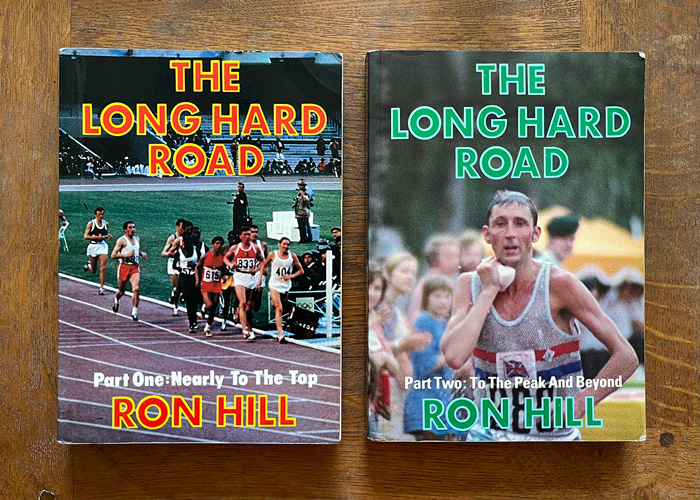
By the time I’d entered Honiton, I’d started to read Ron Hill’s two part autobiography, The Long Hard Road, and decided to copy his refuelling strategy – water and sponges. All I did the night before was eat a big spaghetti meal. As I’ve written, our naïvety produced strength in depth, but also, conversely, lots of wobbly non-finishers.
Sunday 17th October 1982
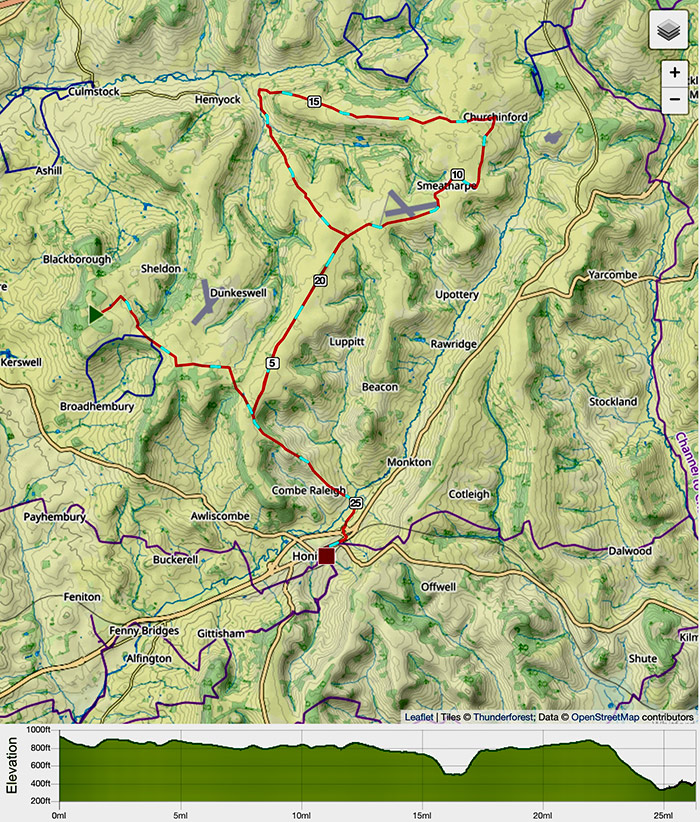
For the life of me I cannot remember who gave me a lift to Honiton for the race. I think there were several cars involved as quite a few Harriers ran this marathon. However, this was also the first race that I’d written up in my diary, so the following is a mildly edited version of my original written account (with a few comments in brackets). The race itself started at the Forest Glade campsite, then tracked over the very exposed Luppitt Common, round a large, undulating loop, then back over the Common into Honiton. It was not an easy course – exposed and hilly at the wrong points. I’ve plotted the route from memory to add to this blog. I had no sports watch. Thus stopped my Sekonda wristwatch by pulling out the winder, set all hands on 12:00 and pressed the winder in at the start. It recorded the hours, minutes and seconds, and was so accurate, it was exactly the same as the official time.
On to my training log for the day:
“I was nervous over the start of this, my first marathon. Once we arrived at Forest Glade, I changed, used Vaseline in strategic places, had a good rub with spirit liniment (Get this the wrong way around and it is deadly!) and had a final piddle. I tossed my kit bag into a pile for the finish and faced the grey day. The weather was not too cold, but a southwesterly was blowing, with showers at times.
Out to the gathering area and I was carried along by the army of runners towards the start. A few stretches and, “CRACK!” We were off – my nerves soon disappeared once I’d started. I settled into a 7:30 pace and held myself back as dozens of people raced by. Burni had warned me against getting carried away, so I stuck to the plan – I thought I might see them later. I was determined not to go off too fast, as I had done in the Burnham Half. The first mile marker proved I was at 7:30 pace and I settled down with two older runners. (One of these was a chap called Gordon Offer-Hoar, so I remember. I met him again in the following year’s London Marathon.) The wind was no bother up to Limers Cross and along Luppitt Common as it was behind us. I took a mouthful of water at 3 miles and missed the 6 mile station. My two partners were sticking with me at this point and up to 10 miles I was still running 7:30s. I had a cup full of water at 9 miles and felt comfortable – but was glad our trio had decided to share the pace.
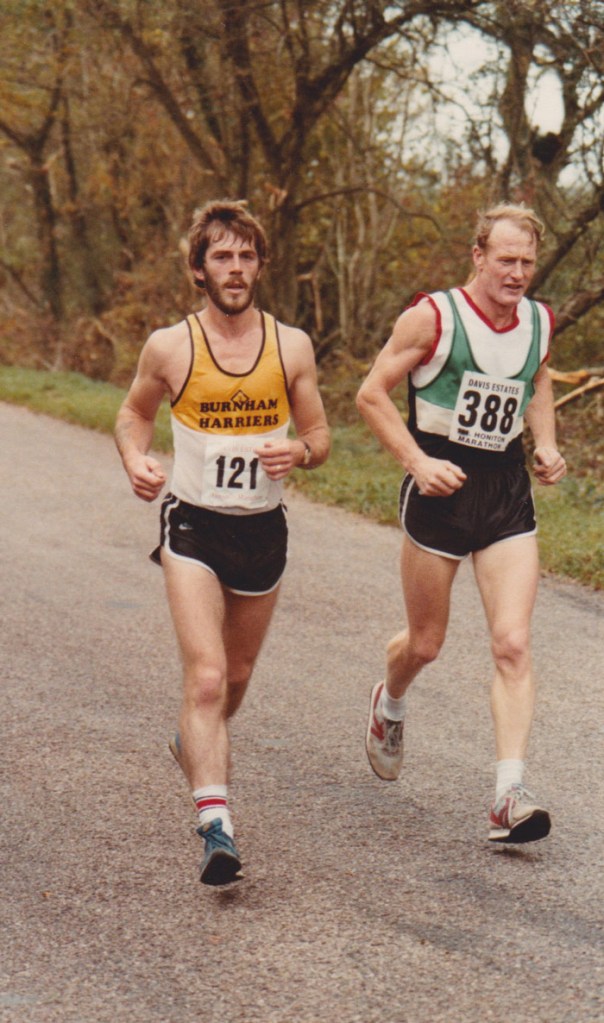
The course was a generally uphill until 11 miles then it was undulating around the big loop. I took another good drink at 12 miles, then we turned into that wind. At 13 miles I ran through a race marshal’s checkpoint (before timing chips, your number was noted at various points to prove you’d completed the distance) and from here it was uphill into the rain for several minutes. My two companions started to slow down and I moved away alone. Oddly, this gave a me surge of strength and I went into a trance-like auto-7:30 pace, even though I was running against the wind. 14 miles was passed with no trouble, though my feet were wet and uncomfortable. I had a drink of XL-1 (Electrolyte drink of the day.) at 15 miles and still felt strong. As I ran back across Luppitt Common I began to pass lots and lots of flagging runners. Burni had been spot on – sticking to an even pace was beginning to pay off.
I was now waiting for the legendary ‘wall’ to overcome me, but a drink at 18 miles found me still feeling capable of sustaining 7:30 pace. I began to wilt a shade over the the next three miles and three people overtook me, though I had by now overhauled dozens of struggling runners. A good drink at 21 miles picked me up. From here the course was, in the main, downhill. In spite of being tired, I focussed on the occasional runner in front, passing several more up to 23 miles. I had now gone further than ever before. I had slowed a little, but my cadence remained the same. (I’m lucky enough to be able to instinctively stick to a steady pace/cadence, even now.) I totally missed the 24 mile drink, though I took a sponge. All I had to do was hang on.

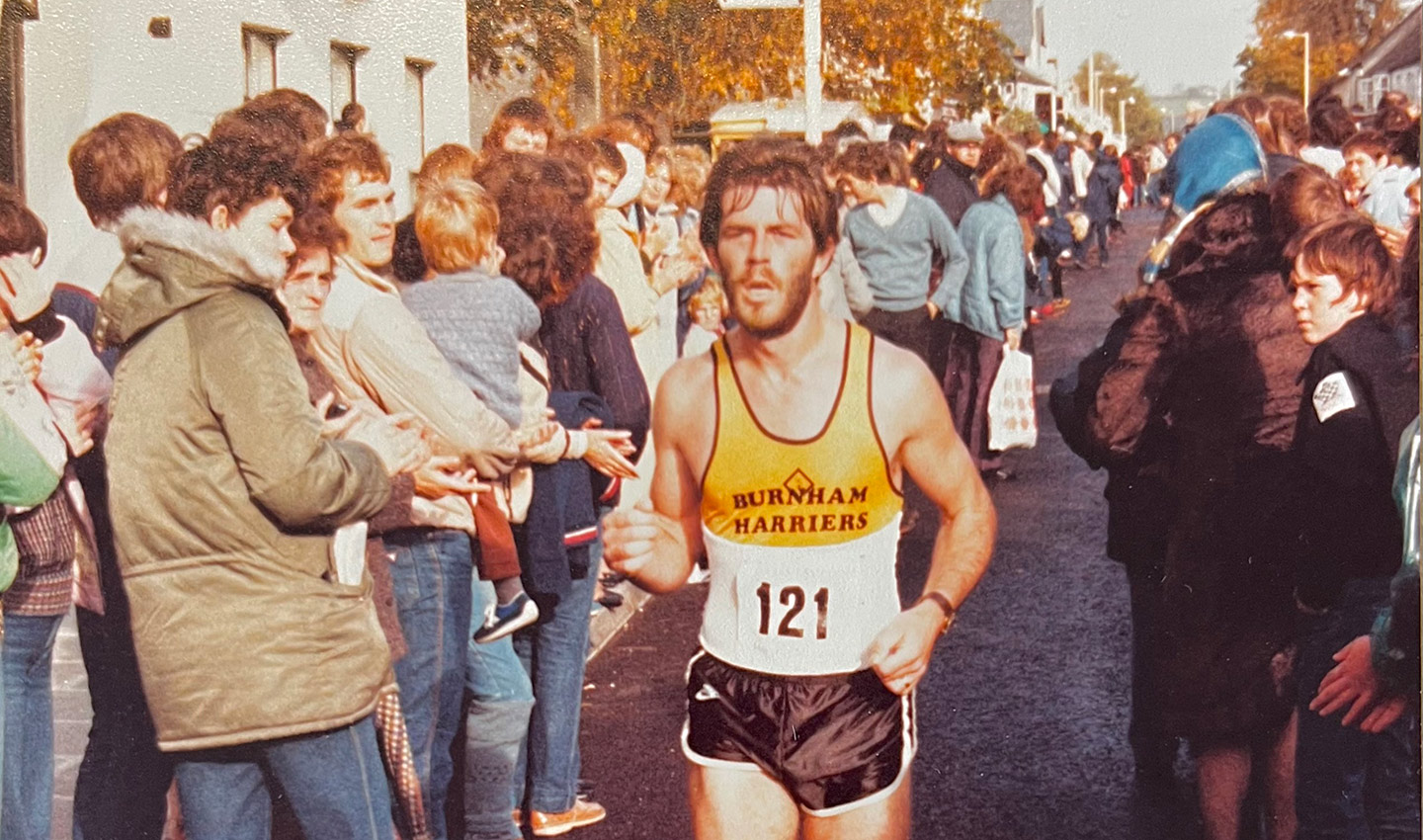
The final few miles of the course were downhill to the town and my pace picked up again. I passed another walking marathoner who looked wet, cold and done in. I felt like I was sprinting through 25 miles and over Langford Bridge. I ran up the last rise into Honiton proper, where I overhauled one more plodding runner just before I turned the corner into the High Street. The cheers and applause lifted me to one final effort and I crossed the finish line. I staggered along, had a medal placed around my neck, grabbed a drink and took stock. I was cold, tired and wet, but never felt better. My first marathon was over. 3:22:54.
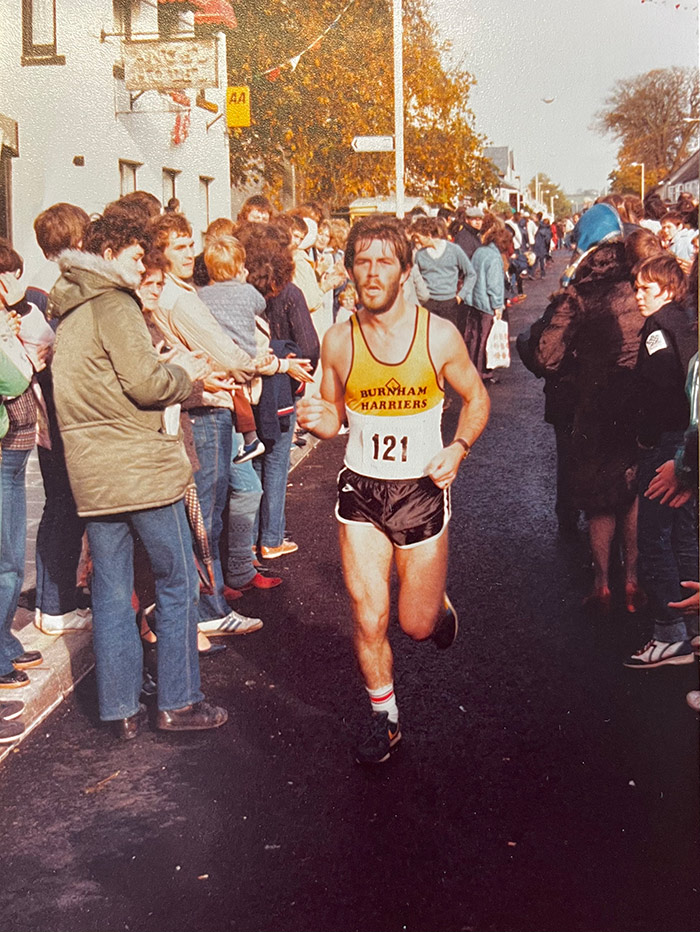
I had done what I wanted, cracked 3½ hours! I had averaged each mile in around 7:45, even though for ten miles I had run against the wind! (In retrospect I’m sure the run back against the wind had slowed me to 8 minute miles, but that I made up time in the final downhill section.) I never hit the ‘wall’, but rather eased through it at around 19-21 miles – Burni’s coaching had worked.
What have I learnt?
- Get in the training – it pays off.
- Forget everyone else and set off at a steady, maintainable pace (one you’ve trained for).
- Only increase the pace when and if you feel it is reasonable to do so.
- Drink and sponge as you feel, not to a set pattern (I missed 6 miles and 24 miles).
- Plan ahead to reap the rewards.
From now I hope to run through the winter, perhaps training for specific, shorter races, until I know when my next marathon will be. I hope to increase my speed a bit and my endurance-at-speed capabilities. I will try to use my own schedules from now on.”
Honiton Marathon 1982
Time: 3:22:54
Position: 97th
Pace: 7:44
Reflections on 1982
It was a formative year for me, in many ways. As a young father and family man on shift work, it had been hard to find a sport that suited me. I had no social life and felt trapped in the cycle accepted as the norm: work-eat-sleep. Running proved to be perfect escape. I became obsessed with running. I read every magazine and book. The advice I received from the older Burnham-on-Sea Harriers put a brake on my constant, eyeballs-out training techniques.
One can get fit quickly, if you put in the work. I had turned 26 just before Honiton 1982 and my body adjusted rapidly to hard exercise. I approached 1983 with a clear focus. I wanted to see if I was capable of getting below a 3:15:00 marathon. I still had a lot to learn…
Tips from an Ancient Harrier – No.2: Core
Many runners forget to strengthen their core. In the early days, I’d only do press ups and sit ups, relying on running on hills or sand to take care of the rest. As I got older I came to realise that my core strength held everything together. So, fit in a weekly core session – planks, squats holding a weight, etc. Stretching is part of the whole. This becomes even more relevant as you get beyond your 40th birthday. Make this a regular part of your week.
All website content ©Paul Comerford, author, unless otherwise stated. All rights reserved.
 Paul Comerford