27th April 2022…
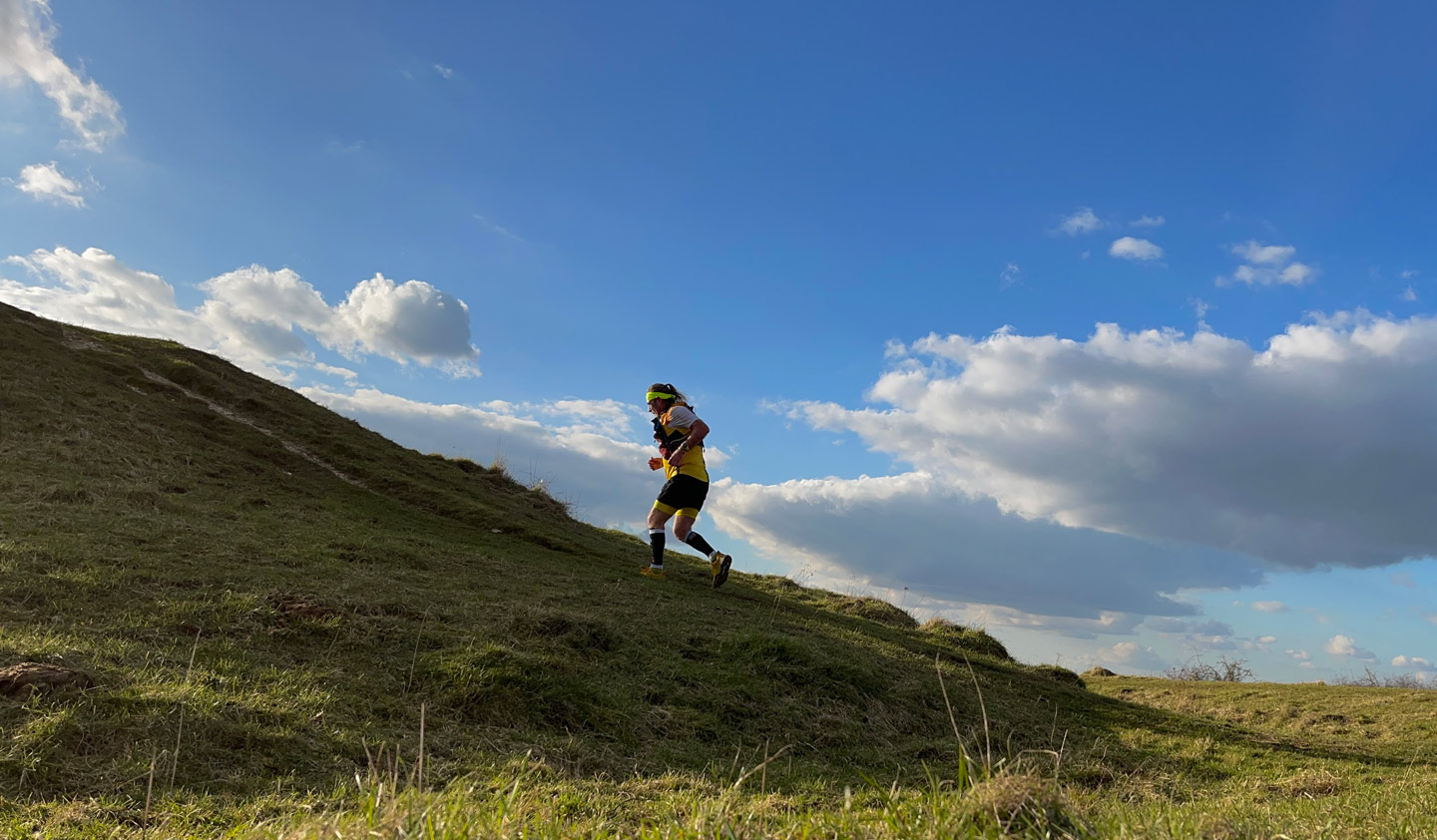
…Up ahead I could see the long climb to the top of the South Downs. The Reaper Man was well behind me now, but my right leg had decided to give him a chance. This was not new – I’d been ignoring the injury’s effects for more than a year.
I’d already covered 15 miles from the coastal trails at Nutbourne, up the Centurion Way, over the Trundle and down to my crew – my Passepartout (now wife, Ange) and my great pal and Personal Trainer, Martin Sorenson. A quick change of shoes, from Hoka ATRs to Speedgoats, a refill of Tailwind, and on the trails to Singleton. My body was fit. Heart and lungs and muscles fine. You see, I’d decided that strengthening the muscles around the injury would nullify it. A brilliant concept – what could possibly go wrong?!
Just three weeks before this 32-mile training run, I’d completed a 4:15 marathon at Goodwood. I was in good shape for a 66-year-old veteran, running faster than all but one stalwart above the V50 category. However, I knew I could have been faster – my right leg had kept giving way… What an odd position to be in. My fittest ever, in real terms, yet carrying a long-term, chronic injury which was not quite going away.
Beyond Singleton the big climbs lay waiting. I’d deliberately placed the hard trails in the second half of the route to simulate my goal – the Race to the King 100k. Levin Down was the first test – my right leg started to give way again. This was the odd thing, I had no real pain, except my Achilles – which I thought was normal for a runner of my age, by the way. My leg would just briefly disappear from my brain’s circuitry. Then, I was okay again.
I was now going uphill through the Singleton Forest, having to resort to race walking in deference to my leg, cresting the hill of Heyshott Down somewhat bewildered, having covered the mile in over 15 minutes. I turned west, and ran down to my crew at the Hilltop car park, covering the ground below 9-minutes a mile. I felt great. I’d covered 19 miles and felt full of running. Yet, it was here I began to realise my strategy of shoring up an injury and ignoring it was reaching a predictable conclusion.
Leaving my Crew, I scaled Cocking Down, then turned to race downhill to just beyond Staple Ash Farm. This is where the full impact of the injury finally hit me. I couldn’t run downhill on rough trails. My right leg was numb and my foot seemed detached. It wouldn’t land securely on the uneven ground. By the time I’d reached my Crew, I was crestfallen. I stretched and limbered up, then headed on, running at a reasonable 10-minute mile pace on the smooth, tarmacked surface, wondering how I could feel so full of running, yet be breaking down at the same time.
My resurgence lasted until the brutal climb up Stoughton Down and over Bow Hill to the Devil’s Humps at Kingley Vale. My Garmin showed exactly 26 miles at this high point. It was mainly downhill to the coast from here. My leg was no longer mine to control, and no matter how well I felt, my journey to race 100km came to a crushing halt as I bimbled home. I’d covered the 32 miles at an average of 12:45 minutes per mile, practically one-legged. Pretty good, considering my age and the tough route I’d chosen, but I knew it was over. It was time to face facts – I needed to rest, repair and recover, no matter how long it took. I dropped out of the Race to the King shortly after.
At the same moment, I’d lost the final chapter of my coming book, Racing the Reaper Man – A guide for the long run. More of that later.

34 months later…
Sometimes life gets in the way of living. From that 32-miler in April 2022, to the time of writing, February 2025, my world changed completely. The only thing related to running was, I finally listened to Ricky Leadbetter, my brilliant physio, and let my body repair. Everything else was a rollercoaster of extremes.
I’m 69 years old later this year. How the hell that happened is beyond me. I was 18, blinked and 50 years disappeared! I’m sure most of us above 60 (or even 30, 40 or 50) will know that feeling. We often look back at old photographs and wonder how we got to our now. Well, that is time. From then until now, is time travel. And there’s the rub – it is a continuous forward journey along a varied trail of highs, lows, hell and high water. From those pictures in dusty albums, or instantly posted pictures on social media we tend to grin through reality, giving the idea that happiness is constant. We tend not to project sadness, heartbreak and fear. Uncertainty is avoided. The only certain thing, however, is that our long run through life will not end well. Fear not, it doesn’t have to be that way on our journey. Being knocked down is inevitable, at times, it is our response to the travails of life that is important. Let me explain…
My own view comes from 68 years of living life’s journey. I’m a rebel. Not in the rootin’, tootin’ hollerin’ way, but against the way society and culture inflicts faux reality upon us. I hate imposed lifestyle models. I despise the imposition of ideology, mythology and the new tendency for our species to embrace a type of self-imposed dementia, driven by begrudgers with instant access to that intellect-challenging drain, social media. Conversely, I love the way social media can be used to bring colour, hope and humanity to our lives. As a tool, it can be used beautifully, or can be weaponised. It is the minds behind its use that determines what you are, and what you will become. Without learning, adjusting and setting positive waypoints ahead, it is possible to become the living dead by stopping, withering and waiting to kark it. Thus, I rebel against self-imposed stupidly, dogma and age-based defeatism.
My last 34 months have been a lifetime in themselves. I will be as candid as I can be, here, as my aim is to throw a light onto how real life is multidimensional and that behind every snapshot in time, is a person on that roller coaster. To reach February 2025, the following events befell me:
- Burnout wrecked my mental health, leaving me with agoraphobia, PTSD and a damaged immune system.
- There was one moment when suicide seemed the only option.
- I have had to fight to expose hidden breaches of law against a large government organisation, which has taken 3-years to be accepted and acted upon.
- The affect on my immune system was catastrophic, and meant I contracted a virus every couple months up until the end of 2024.
- I’ve had severe prostatitis – at first diagnosed as cancer.
- I’ve undergone a colonoscopy and waited for 3 months to know if I’d developed cancer.
- I’ve had skin cancer removed from my chest.
- It took 18 months to recover from a long-term injury.
As I waded through this, the following happened:
- My sister-in-law died and my brother was hospitalised.
- My son was in a coma for a week.
- He died the following year.
More positively:
- I retired.
- I married my Passepartout.
- I’ve recovered from injury.
- I’ve entered a 50k in April.
- I’ve entered a 100k in June.
My reason for laying this out before you, is that I want to show that life can be brutal, aging can increase our travails, but if we choose, we can still live life to the full. I’m no more special than any other human. What I can get through, anyone can. Grief, joy, sorrow and laughter are all pieces of the jigsaw that make us what we are. How could I deal with so many new sorrows? I found advice, no matter how well meant, differed alarmingly from one source to the next. So, being me, I decided to figure things out for myself. I aim to share this with you.
Friday 28th February 2025
… after covering the 5½ miles of mixed terrain from home, I reach West Stoke. I turn and start the big climb to Stoke Clump. The seemly gentle slope is relentless, but I keep running with short strides, ignoring the urge to deploy my carbon fibre poles, strapped to my pack. The climb becomes severe in places, so I race-walk and run as the effort levels demands. Over the top and the wooded bowl of Kingley Vale is before me, but it is skirted by my old nemesis, Bow Hill.
I run down the muddy trail then start up the ever-steepening slope of Bow Hill. I deploy my poles – the first time I’ve used them in anger. I’m now 7 miles out on this brutal run, my legs are strong, but tired and my confidence is low. I race-walk the insane bits, but reach the top to the place where, 34 months earlier, my leg was finally giving out. Yes, I’m panting like a steam train, but my legs are fine. I’m in the middle of my longest run since then – 14 miles of trails and hills. I’m doing this a couple weeks earlier than I’d scheduled, but I was never patient, so why not see what happens on this monster run? I’m not liking the poles, so fold them and return them to my pack.
I turn west and trot along the ridge to the Devil’s Humps, Bronze Age barrows overlooking the deep bowl of Kingley Vale. I’m 9 miles in and feeling bloody knackered, but solid. More trails and hills, then down the long haul through the woods to Adsdean. I’m lacking speed, but am well ahead of the pace I’m looking at for April’s 50k, and we’ll up on my projected 100k pace for my race in June. I cover the ground quicker across the lesser slopes and trails home, averaging 11:45 pace for the whole route.
I’m back! Finally, after so long, my body isn’t broken. Now all I have to do is get enough training into my legs to have a chance to finally start and finish the Race to the King. Making a come back at 68, after so much pain, requires a certain amount of eccentricity, bloody mindedness and, dare I say, unrequited desire.

So…
….how DO you run 100k? The immediate answer is, I have no idea! I’ve read every relevant ultramarathon book, watched scores of videos and scrolled the Interweb until my mind went blank. The fact is, you don’t know until you’ve completed one, as far as I can establish. Upon reflection, there is a certain insanity quotient involved. There has to be, hasn’t there?
Of course, I couldn’t leave it there, as I’m already fully signed and paid up to compete in this year’s Race to the King, so these next few posts will show you what I’m doing, why I’m doing it this way and the philosophy behind my endeavours. This newer series of blogs will finally lead to a book, which will contain nothing but the application of my own experience and lessons learnt, with no flannel. Before I can write it, I must first of all get through that 62.14 miles.
February Philosophy – Giving up is an option, but don’t…
I’m haunted by this verse from a poem by Philip Larkin, called The Old Fools:
What do they think has happened, the old fools,
To make them like this? Do they somehow suppose
It’s more grown-up when your mouth hangs open and drools,
And you keep on pissing yourself, and can’t remember
Who called this morning? Or that, if they only chose,
They could alter things back to when they danced all night,
Or went to their wedding, or sloped arms some September?
Or do they fancy there’s really been no change,
And they’ve always behaved as if they were crippled or tight,
Or sat through days of thin continuous dreaming
Watching light move? If they don’t (and they can’t), it’s strange:
Why aren’t they screaming?
Bloody hell, Larkin! He was a bit curmudgeonly in his later work. Yet, he had the habit of hitting a nail squarely on its head. To me, getting older is one thing, giving in to old age is another. Being 68 is something I had no experience of, until I got there, so, as I noted above, I’ve decided to work it out for myself.
For me, I cannot conform to giving in. I tried it once, and nobody noticed. If one is content to reach a perceived old age – this can be as young as 40, 50, or 60 – and become the culturally accepted elderly, so be it. By this, I mean:
- Acquiring the uniform of sensible clothes, figure disguising tops, and saggy-arsed trousers.
- Getting rounder, redder in the face and wearing one’s hair like everyone else.
- Getting louder about politics, shouting at the telly and being worked up by misunderstanding the word ‘Liberal’.
- Only reading things that supports one’s personal bias – regardless of it veracity.
- Shouting down anyone who threatens the norm.
- Hoping everything will be alright without working towards giving yourself a fighting chance.
- Using other people’s failures to justify one’s own inaction.
- Finding stairs daunting.
- Not trusting a fart.
If I find myself getting close to any of the above (apart from the very last item on the list), I would start screaming! Thanks, Mr. Larkin.
Becoming fit, being healthy and embracing exercise will change one’s life. With running, I’ve discovered that aging doesn’t mean giving up, but training smarter. After recovering from injury, I’ve adjusted my running mileage, added core strength and stretching exercises, and embraced recovery.
Yes, I’d been getting it wrong in some areas after I reached 60. Recovery is definitely key. After a period of heavy exercise – long runs, speed work, core sessions – what used to take one day to recover, might now take two or three. My muscles, joints, and connective tissues don’t bounce back as quickly, which means training has to adapt. It’s that old chestnut: listen to your body instead of blindly following rigid training plans.
So:
- First. Do add strength training. Muscle mass will naturally decline with age, but strengthening the core, arms and legs will mean it can be delayed, reversed even, to a point. Stronger limbs and stable joints will reduce injuries.
- Second, adjust your mileage and intensity wisely. Feel happy about inserting a lower mileage week during a half-marathon, full marathon or ultramarathon build-up. Focus on recovering after quality sessions such as tempo runs, hill workouts, and strategic long runs, to build endurance without overloading your body. (Cross-training can help keep one’s cardiovascular fitness high i.e. – cycling, swimming, or rowing etc.)
- Third. Yep, give your body more time to recover. Sleep becomes even more critical as you age—seven to nine hours of deep rest will make a massive difference in recovery, performance and energy levels.
- Lastly, with core work ensure mobility exercises are included. Inflexibility becomes more common with age, but stretching, foam rolling, and yoga can help keep joints and muscles elastic. A gentle warm up before a run, and good stretching session after a run will help avoid injury.
At 68 I’m not the same as I was when I first began running at 25. In those 43 years I’ve had to adjust, often learning the hard way, but even at my lowest never really given up.

How I’m training for 100k – January & February 2025
I’ve lost speed. Although my running streak remains intact, 1528 days and counting, my runs over the last couple years have been low key and low mileage. At 65 I was covering 50k at 10:15 per mile, and 5k in 25 minutes, but now, at 68 and post injury, I’m having to be patient. 100k is not about speed, but endurance of body and mind. Thus, I’m concentrating on strength and making sure my long runs are mainly on trails. Speed will follow.
So, in January I doubled my monthly mileage to 85, with 2 long runs of 10 miles. February’s mileage grew to 101 miles, culminating in that hefty 14. They were big hills, too. Every week I have a hard, one-hour core strength session with my great pal and Personal Trainer, Martin Sorenson. I follow this with a series of 60 metre sprints. These latter test my flexibility and power. If you’re in your 7th decade, there is a fine balance to attain if one is to attempt to run ultramarathons. Work-rest-recovery. Everything pivots on rest and recovery, before more hard work. My increased mileage has made me tired. I often don’t sleep well enough to recover. Then, the key runs become harder. Thus, I will work on sleep quality.
My aim in June’s 100k is to hit one of three goals. If everything goes wobbly, 16+ hours will be okay. If I stay in good order and run at the level I am now, sub-16 hours should be achievable. If I have the perfect day – let’s be brave and look at 14 hours, 59 minutes, 59 seconds.
How do you run 100k? A dear pal, Sarah, has already completed a couple of 100k races, including the Race to the King. Her answer to the question was a very accurate, “You don’t, you walk part of it!” Quite! In the end it’s just putting one foot in front of the other until it’s over. Giving up is always an option, but don’t…

All website content ©Paul Comerford, author, unless otherwise stated. All rights reserved.
 Paul Comerford